

Best Places for Whale Watching California
Around 20,000 gray whales swim past the California coast twice a year, and most of them pass within a few miles of the beach. Add blue whales in summer, humpbacks from spring through fall, and the odd pod of orcas, and you get a state where something large is in the water every month. The hard part is choosing where to go. This guide covers the best places for whale watching California has to offer, what you can expect to see at each one, and which months give you the strongest odds.
Some of these spots need a boat. Others need a pair of binoculars and a windproof jacket. Both count.
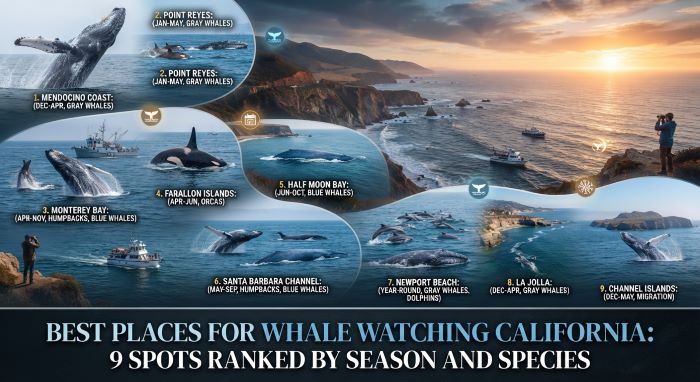
Best Places for Whale Watching California: Quick Comparison
Here is the short version before the details.
| Place | Best months | Main species | Boat or shore |
|---|---|---|---|
| Monterey Bay | April to November | Humpbacks, blue whales, orcas, gray whales | Boat |
| Dana Point | Year-round | Gray whales, blue whales, dolphins | Boat and shore |
| San Diego | December to April, June to September | Gray whales, blue whales | Boat and shore |
| Santa Barbara Channel | May to September | Blue whales, humpbacks | Boat |
| Point Reyes | January, March to April | Gray whales | Shore |
| Mendocino Coast | December to April | Gray whales | Shore |
| Palos Verdes (Point Vicente) | December to May | Gray whales | Shore |
| Half Moon Bay and the Farallones | June to November | Humpbacks, blue whales | Boat |
| Big Sur | December to April | Gray whales, humpbacks | Shore |
1. Monterey Bay
If you have time for one trip, make it this one. Most lists of the best places for whale watching California can claim put Monterey Bay at the top, and the reason sits under the water.
The Monterey Submarine Canyon starts close to shore near Moss Landing and drops to depths that rival the Grand Canyon. Cold, nutrient-rich water rises from that canyon and feeds huge schools of anchovies and swarms of krill. Whales follow the food. That means boats reach feeding grounds in under an hour instead of spending half the trip in transit.
What you can see:
- Humpback whales from about April through November. They lunge feed at the surface and breach more than most species.
- Blue whales in summer and early fall, when krill is thick.
- Gray whales from December through April on their migration.
- Orcas at any time, with the best chances in April and May when they hunt gray whale calves near the canyon edge.
Trips leave from Monterey’s Fisherman’s Wharf and from Moss Landing. Moss Landing sits at the head of the canyon, so boats there spend less time getting to deep water.
2. Dana Point
Dana Point holds the trademark “Dolphin and Whale Watching Capital of the World,” and in 2021 it became the first Whale Heritage Site in the Americas. The claim has substance. The headlands push out into the Pacific, and gray whales use them as a landmark on their route.
The town runs trips every day of the year. Winter brings gray whales. Summer brings blue whales, which feed off the Orange County coast from about May into October. Between whale sightings, you get dolphins. Pods of common dolphins here can number in the thousands, and they ride the bow wave of almost every boat.
Dana Point also hosts the Festival of Whales each March. If you want shore viewing, walk the trails at Dana Point Headlands and scan the water from the bluff.
3. San Diego
San Diego is the last major stop for gray whales before they reach the lagoons of Baja California, where they breed and give birth. From mid-December through April, they pass close to Point Loma in steady numbers.
You have two good options:
- By boat: Trips leave from San Diego Bay and Mission Bay. The ride to open ocean is short.
- From shore: Cabrillo National Monument has a whale overlook on the western side of Point Loma. On a clear January day, you can count blows from the railing.
Summer changes the cast. Blue whales feed offshore from about June through September, and operators run longer trips to reach them. Torrey Pines State Reserve gives you another high, free vantage point north of the city.
4. Santa Barbara Channel and the Channel Islands
The stretch of water between Santa Barbara, Ventura, and the Channel Islands works like a funnel for marine life. The National Park Service notes that about a third of the world’s whale and dolphin species have been seen in these waters.
Summer is the headline season. Blue whales and humpbacks gather in the channel from late spring through September to feed. Seeing a blue whale surface next to a boat resets your sense of scale. The animal can reach close to 100 feet, and its blow rises about three stories.
Trips depart from Santa Barbara Harbor, Ventura Harbor, and Channel Islands Harbor in Oxnard. Winter trips focus on gray whales and take less time. You can also ride the park ferry to the islands and watch for whales on the crossing.
5. Point Reyes National Seashore
Point Reyes sticks ten miles out into the Pacific, which puts you closer to the migration route than almost any other point on the mainland. You do not need a boat here.
Two spots do the work:
- Point Reyes Lighthouse: The observation deck sits high above the water. The walk down to the lighthouse itself takes more than 300 steps, and the park closes those stairs in high wind.
- Chimney Rock: A gentler trail with wide views and spring wildflowers.
Mid-January is the peak for southbound gray whales. Mid-March is the peak for the northbound trip. Mothers with calves come last, in April and early May, and they tend to hug the shore. On busy winter weekends, the park has run a shuttle to the lighthouse, so check its site before you drive out.
6. Mendocino Coast
Mendocino takes whale season to heart. Three towns hold whale festivals on separate weekends in March: Mendocino, Little River, and Fort Bragg. The timing matches the northbound gray whale run.
The coast here is all headlands and bluffs, which makes shore viewing easy. Good spots include:
- Mendocino Headlands State Park, a short walk from the village
- Point Cabrillo Light Station, a few miles north
- MacKerricher State Park near Fort Bragg, which has a boardwalk out to a viewing point
Small charter boats run from Noyo Harbor in Fort Bragg for people who want a closer look. The sea can be rough this far north, so pick a calm morning.
7. Point Vicente, Palos Verdes
For anyone in Los Angeles, this is the easiest entry on the list. The Point Vicente Interpretive Center in Rancho Palos Verdes sits on a bluff above the ocean, costs nothing to visit, and has a small museum on local marine life.
Volunteers with the American Cetacean Society run a gray whale census from the patio each year from December through May. They count every whale that passes during daylight hours and post the numbers. Stand near them and you get expert spotters for free. Among the best places for whale watching California offers from dry land, this one asks the least of you: park, walk fifty yards, and look west.
8. Half Moon Bay and the Farallon Islands
About 27 miles west of San Francisco, the Farallon Islands sit at the edge of the continental shelf. The waters around them fall inside a national marine sanctuary, and from June through November they fill with humpbacks and blue whales.
Trips leave from San Francisco and from Pillar Point Harbor in Half Moon Bay. Know what you sign up for. These are full-day outings on open ocean, and the swell can be heavy. If you get seasick, take your remedy the night before and again in the morning. The payoff is big: whales, sea lions, thousands of seabirds, and a real chance of seeing a great white shark in fall.
9. Big Sur
Highway 1 through Big Sur runs along cliffs hundreds of feet above the water. That height turns every pullout into a lookout. Gray whales pass from December through April, and humpbacks show up in summer and fall.
Try the overlook trail at Julia Pfeiffer Burns State Park, the bluffs at Garrapata State Park, or any wide turnout with a clear view south. Bring binoculars. The whales are farther down than they look.
When to Go: California Whale Seasons
Timing matters as much as location. The best places for whale watching California lists shift with the calendar, so match your trip to the species you want.
- December to February: Gray whales head south. Go to San Diego, Dana Point, Point Vicente, or Point Reyes.
- March to May: Gray whales head north with calves. Go to Mendocino, Point Reyes, or Monterey Bay, where orcas hunt.
- June to September: Blue whales and humpbacks feed. Go to the Santa Barbara Channel, Monterey Bay, or Dana Point.
- October to November: Humpbacks linger. Go to Monterey Bay or the Farallones.
There is no dead month. That fact alone sets the state apart from most whale watching regions.
Boat Trip or Shore Viewing?
Each has a place.
Choose a boat if you want to see blue whales or humpbacks, want photos, or have one day and need strong odds. Boats go where the whales are. Many operators offer a free return trip if you see nothing.
Choose the shore if you travel with small kids, get seasick, or want to spend nothing. Gray whales are the species for this. They swim close to land and follow the same route each year.
A naturalist on board adds a lot. Ask before you book whether one comes along.
Tips for a Better Day on the Water
A few habits raise your odds at all the best places for whale watching California has along its coast.
- Go in the morning. Wind builds through the day. Calm water makes blows easier to spot and rides easier on the stomach.
- Dress in layers. It is colder on the ocean than on the dock, even in August.
- Look for the blow first. A puff of mist on the horizon is the sign. Watch that spot, since whales tend to surface several times in a row before a deep dive.
- Bring binoculars for shore viewing. They matter more than a camera.
- Pick a higher vantage point. Height lets you see past the surf line and over the swell.
- Give whales room. Federal guidelines ask boats to stay at least 100 yards away. Good captains follow them and let the whale decide how close to come.
Common Questions
What is the best month for whale watching in California? It depends on the species. January and March are best for gray whales. July and August are best for blue whales. September is hard to beat for humpbacks in Monterey Bay.
Can you see whales from the beach? Yes, during gray whale season. Headlands and bluffs work better than flat sand.
Which of the best places for whale watching California has is closest to Los Angeles? Point Vicente for shore viewing. Long Beach, Newport Beach, and Dana Point for boats.
How long do trips last? Most run two to four hours. Farallon Islands trips take a full day.
Are sightings guaranteed? No. These are wild animals. Monterey Bay and Dana Point report sightings on most trips, which is why they rank so high.
Key Takeaways
- The best places for whale watching California offers are Monterey Bay, Dana Point, San Diego, the Santa Barbara Channel, Point Reyes, the Mendocino Coast, Point Vicente, the Farallon Islands, and Big Sur.
- Monterey Bay is the top pick for variety. A deep submarine canyon close to shore draws humpbacks, blue whales, gray whales, and orcas across most of the year.
- Dana Point runs trips every day of the year and was named the first Whale Heritage Site in the Americas in 2021.
- Gray whales pass from December through May. They swim close to land, which makes them the best species to watch from shore.
- Blue whales and humpbacks feed off California from about June through September. You need a boat to see them well, and the Santa Barbara Channel and Monterey Bay are the strongest bets.
- Point Reyes, Mendocino, Point Vicente, Cabrillo National Monument, and Big Sur all offer free shore viewing. Bring binoculars and stand as high as you can.
- Mid-January and mid-March are the peak weeks for gray whales at Point Reyes. Mothers with calves follow in April and early May.
- Go in the morning, dress in layers, and watch for the blow on the horizon before you look for the whale itself.
- No sighting is guaranteed, so book with an operator that offers a return trip and carries a naturalist on board.