

How Long Does an Internship Interview Take? Typical Times for Each Format
You have an email with a calendar link, a class at two, and a shift at five. Before you pick a slot, you need one fact: how long does an internship interview take? For most students the answer is 20 to 60 minutes. The exact number depends on the format, the round, and the type of company.
This guide gives you typical times for each kind of interview, explains what fills those minutes, and shows you how to prepare so the time works in your favor.
How Long Does an Internship Interview Take on Average?
Most internship interviews fall into three bands:
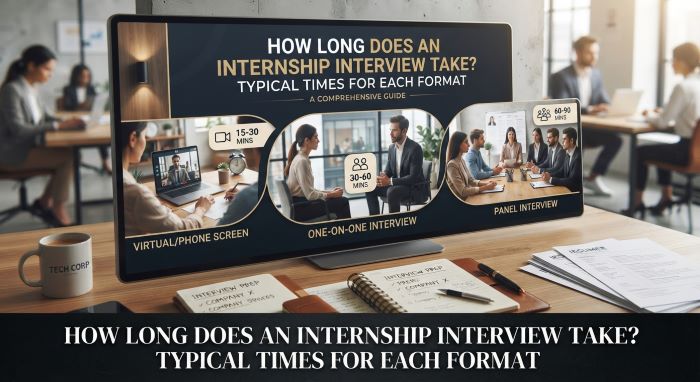
- 15 to 30 minutes for a first phone or video screen
- 30 to 45 minutes for a standard one-on-one interview
- 45 to 60 minutes for an in-person, panel, or technical interview
Final rounds can run much longer. Large firms in finance, consulting, and tech sometimes hold several back-to-back sessions that add up to two to four hours.
Internship interviews tend to be shorter than interviews for full-time roles. Employers know you have limited work history, so they spend less time on past jobs and more on how you think, learn, and communicate.
Typical Length by Interview Type
The answer to “how long does an internship interview take” changes most with the format.
| Interview type | Usual length | What happens |
|---|---|---|
| Recruiter phone screen | 15 to 30 minutes | Background, interest, dates, logistics |
| One-way recorded video | 10 to 25 minutes | Timed answers to preset questions |
| Live video interview | 30 to 45 minutes | Behavioral questions, resume review |
| In-person interview | 45 to 60 minutes | Deeper questions, often an office tour |
| Technical or case interview | 45 to 60 minutes | Coding, case study, or skills task |
| Panel interview | 45 to 60 minutes | Two to four interviewers at once |
| Final round or “superday” | 2 to 4 hours | Several interviews in a row |
| Assessment center | Half a day to a full day | Group tasks, tests, interviews |
These are common ranges, not rules. If your invitation states a length, trust that over any table.
Phone Screen
A recruiter checks the basics: your year, your major, when you can start, and why you applied. Expect two or three light questions. It moves fast.
One-Way Recorded Video
You log in to a platform, read each question, and record your answer within a time limit. You may get 30 seconds to think and one to three minutes to speak. The whole thing can take under 20 minutes, though you should allow extra time for setup and a practice question.
Live Video or In-Person Interview
This is the main event. You speak with the hiring manager or a team member. They walk through your resume, ask behavioral questions, and leave time for your questions at the end.
Technical or Case Interview
For software, data, engineering, finance, and consulting roles, you may solve a problem live. A coding interview often runs 45 to 60 minutes with one or two problems. A case interview runs 30 to 45 minutes.
Final Round
Some employers bring all finalists in on one day. You meet several people in separate sessions of 30 to 45 minutes each, often with a lunch or a group exercise between them.
What Happens Minute by Minute
A 30-minute interview tends to follow the same shape.
- Minutes 0 to 3: greetings and a short outline of the role.
- Minutes 3 to 6: “Tell me about yourself.”
- Minutes 6 to 20: four to six questions about your experience, skills, and interest.
- Minutes 20 to 27: your questions for the interviewer.
- Minutes 27 to 30: next steps and the timeline.
That leaves about two minutes per answer. Practice answers that fit that length. A four-minute answer in a 30-minute slot costs you a whole question.
What Affects the Length
No single number answers “how long does an internship interview take” for every employer. Several things stretch or shrink the clock.
- Company size. Large firms run fixed, timed interviews so each candidate gets the same treatment. Small firms and startups are looser.
- Industry. Technical fields add tests. Creative fields add portfolio reviews.
- Round. First rounds are short. Later rounds dig deeper.
- Number of interviewers. Each extra person brings extra questions.
- Your answers. Clear, focused answers keep things on pace. Long answers push the interview over or cut questions short.
- Rapport. A good conversation often runs past the planned time.
- The interviewer’s day. Back-to-back meetings force a hard stop.
Does a Short or Long Interview Mean Anything?
Students read a lot into the clock. Be careful with that.
A short interview is not a rejection. Screens are short by design. An interviewer with a strict schedule may end right on time with every candidate. Some decide fast because they liked what they heard.
A long interview is not an offer. It can mean real interest. It can also mean a chatty interviewer or a slow start.
Better signs than length:
- The interviewer explains next steps in detail.
- They ask about your start date and availability.
- They describe the team and projects as if you were on them.
- They introduce you to other people.
- They answer your questions with care instead of rushing.
When students ask how long does an internship interview take, they often want to know what the length says about their chances. The honest answer is: not much. Judge the content, not the minutes.
How Much Time to Block in Your Calendar
The question “how long does an internship interview take” covers the interview alone. Your real time commitment is larger.
- For a video interview: block the stated time plus 30 minutes. Log in 10 minutes early to test your camera, sound, and link. Leave a buffer at the end in case it runs over.
- For an in-person interview: block the stated time plus travel plus 30 minutes. Arrive 10 to 15 minutes early. Allow time for a security desk or a tour.
- For a final round: block the whole half day.
Do not book a class, exam, or shift right after. Watching the clock makes your answers worse.
Common Internship Interview Questions
Interviewers draw from a familiar pool. These internship interview questions come up again and again:
- Tell me about yourself.
- Why do you want this internship?
- Why our company?
- What do you know about what we do?
- Tell me about a time you worked on a team.
- Describe a challenge you faced and how you handled it.
- Tell me about a mistake and what you learned from it.
- What are your strengths? What is one weakness?
- Which class or project has taught you the most?
- How do you manage deadlines when several things are due at once?
- What do you hope to learn here?
- Where do you see yourself after graduation?
- Do you have any questions for us?
You may not have work experience to draw on, and that is fine. Use class projects, clubs, sports, volunteering, part-time jobs, and personal projects. Interviewers want proof of effort, teamwork, and learning. The setting matters less.
For technical roles, add role-specific internship interview questions to your list: basic data structures for software, a short Excel or accounting test for finance, or a portfolio review for design.
How to Prepare for an Internship Interview
Good preparation makes a short interview feel long enough. Here is how to prepare for an internship interview in a few focused sessions.
- Read the posting three times. Mark the skills and duties it repeats. Those are your talking points.
- Research the company. Know what it sells, who its customers are, and one recent piece of news. Read the page for the team you would join.
- Build five stories. Pick examples that show teamwork, problem solving, leadership, failure, and initiative. Shape each one with the STAR method: situation, task, action, result.
- Write and time your introduction. Aim for 60 to 90 seconds: who you are, what you have done, and why this role.
- Practice out loud. Record yourself or ask a friend or your campus career center for a mock interview. Speaking an answer is not the same as thinking it.
- Prepare three questions. Ask about the projects interns work on, what success looks like, and how feedback works.
- Check your setup. For video, test the link, light your face from the front, and clear the background. For in-person, plan your route and your outfit the night before.
- Bring the basics. Copies of your resume, a notebook, a pen, and a list of your questions.
If you want one rule for how to prepare for an internship interview, make it this: practice your answers with a timer. Most students know what they want to say. Fewer can say it in two minutes.
What to Do if the Interview Runs Over or Ends Early
If it runs over, stay calm and stay present. Interviewers control the clock. If you have a hard stop, say so with care: “I have a class at three, but I am glad to continue or follow up by email.”
If it ends early, use the gap. Ask one more good question. Then thank the interviewer and confirm the next step.
After the Interview
Send a thank-you email within 24 hours. Keep it to four or five sentences. Mention one specific thing you discussed and restate your interest.
Then wait. Many employers reply within one to two weeks, though timelines vary a lot, and campus recruiting cycles can stretch longer. If the interviewer gave you a date and it passes, send one short, polite follow-up.
Common Questions
How long does an internship interview take over Zoom? Most live video interviews last 30 to 45 minutes.
Is 15 minutes too short? Not for a first screen. That length is normal.
Is 20 minutes a bad sign? No. Many first rounds are set for 20 to 30 minutes.
How many rounds should I expect? One to three for most internships. Large firms may add an online test.
How early should I arrive? Ten to fifteen minutes for in-person. Ten minutes for video.
Key Takeaways
- How long does an internship interview take? Most last 20 to 60 minutes, with phone screens at the short end and in-person or technical interviews at the long end.
- Final rounds at large firms can run two to four hours across several back-to-back sessions.
- A 30-minute interview leaves about two minutes per answer. Practice with a timer so each answer fits.
- Length depends on company size, industry, round, number of interviewers, and how focused your answers are.
- A short interview does not mean rejection, and a long one does not mean an offer. Clear next steps and questions about your start date are better signs.
- Block extra time: 30 minutes beyond the stated length for video, plus travel for in-person.
- Expect questions about yourself, your interest in the company, teamwork, challenges, mistakes, and what you want to learn.
- Prepare five STAR stories, a 60 to 90 second introduction, and three questions of your own.
- Send a short thank-you email within 24 hours and follow up once if the stated timeline passes.