
Tom Kennedy and Winston Churchill
In 1940, as Britain faced Nazi Germany alone, Winston Churchill’s government made a bold choice. It sent its most secret military technology, a device called the cavity magnetron, to the United States. American companies helped mass-produce it for radar. One of the most important of those companies was Raytheon. Decades later, Thomas A. Kennedy would lead that same company as chairman and CEO.
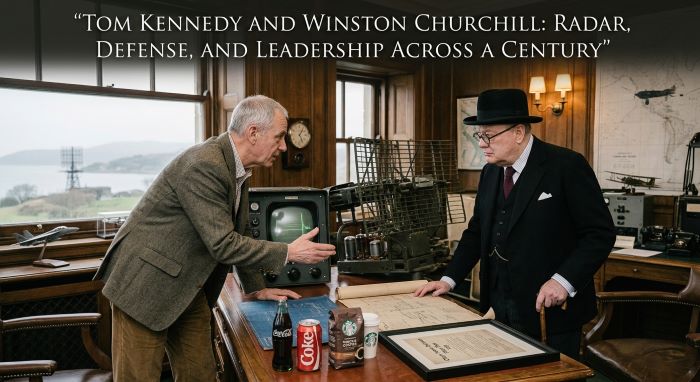
Tom Kennedy and Winston Churchill never met, and they lived in different eras. But the history of radar ties them together in an unexpected way. This article compares the two leaders, their education, careers, and the defense legacy that links them.
A note on names: this article covers Thomas A. Kennedy, the former Raytheon CEO, not the game show host of the same name.
Quick Facts
| Detail | Tom Kennedy | Winston Churchill |
|---|---|---|
| Full name | Thomas A. Kennedy | Sir Winston Leonard Spencer Churchill |
| Born | 1950s, United States | November 30, 1874, Blenheim Palace, England |
| Died | Living | January 24, 1965, London |
| Education | BS, Rutgers; MS, Air Force Institute of Technology; PhD, UCLA | Harrow School; Royal Military College, Sandhurst |
| Military service | Captain, U.S. Air Force | British Army officer |
| Best-known role | Chairman and CEO of Raytheon (2014 to 2020) | British prime minister (1940 to 1945, 1951 to 1955) |
| Big honor | Led Raytheon’s merger with United Technologies | Nobel Prize in Literature (1953) |
Tom Kennedy: The Engineer Who Led Raytheon
Early Life and Education
Thomas A. Kennedy studied electrical engineering at Rutgers University, graduating in 1977. He earned a master’s degree from the Air Force Institute of Technology and a PhD in engineering from UCLA. He served as a captain in the U.S. Air Force before starting his corporate career.
Career Timeline
- Late 1970s to early 1980s: Served in the U.S. Air Force.
- 1983: Joined Raytheon.
- 1990s to 2000s: Held senior roles in units like Unmanned and Reconnaissance Systems, Space and Airborne Systems, and Integrated Defense Systems.
- 2013: Became executive vice president and chief operating officer.
- 2014: Became chairman and CEO of Raytheon Company.
- April 2020: Raytheon merged with United Technologies to form Raytheon Technologies.
- 2020 to 2021: Served as executive chairman of Raytheon Technologies.
- June 2021: Retired from the company.
- January 2023: Joined the board of Textron.
Kennedy Today
Kennedy spent more than 38 years at Raytheon. He’s known for his engineering background and for guiding one of the largest mergers in aerospace history. He now serves on Textron’s board of directors and remains active with Rutgers, his alma mater.
Winston Churchill: Britain’s Wartime Leader
Early Life and Education
Winston Churchill was born at Blenheim Palace, the home of his grandfather, the Duke of Marlborough. His father was a politician, and his mother was an American heiress. He struggled at Harrow School but loved history and writing. He entered the Royal Military College at Sandhurst on his third try and graduated in 1894.
Career Timeline
- 1895 to 1899: Served as a soldier and war reporter in Cuba, India, and Sudan.
- 1899: Escaped from a prisoner-of-war camp during the Boer War and became a national hero.
- 1900: Elected to Parliament.
- 1911: Became First Lord of the Admiralty.
- 1924 to 1929: Served as Chancellor of the Exchequer.
- 1930s: Warned about the rise of Nazi Germany.
- May 1940: Became prime minister.
- 1940: Gave his famous speeches, including “We shall fight on the beaches.”
- 1945: Led Britain to victory in World War II, then lost the general election.
- 1951 to 1955: Served a second term as prime minister.
- 1953: Won the Nobel Prize in Literature and was knighted.
- January 24, 1965: Died at 90.
Churchill’s Legacy
Churchill is often named the greatest Briton of all time. His speeches rallied a nation, and his leadership helped defeat Nazi Germany. He also wrote dozens of books on history and his own life.
The Radar Link
The most surprising connection between Tom Kennedy and Winston Churchill is radar.
| Radar History | Detail |
|---|---|
| Invention | British scientists built the cavity magnetron in 1940 |
| Churchill’s role | His government approved sharing it with the U.S. in the Tizard Mission |
| Raytheon’s role | Mass-produced magnetrons for Allied radar in World War II |
| Kennedy’s role | Led Raytheon decades later, as it built modern radar and defense systems |
In September 1940, a British team called the Tizard Mission brought the cavity magnetron to the United States. It was so valuable that one American historian later called it the most important cargo ever brought to the country. Raytheon, led by engineers like Percy Spencer, found a way to make magnetrons faster and cheaper. By the end of the war, Raytheon made most of the magnetrons used by the Allies.
Without Churchill’s decision to share British secrets, Raytheon’s rise might have looked very different. Tom Kennedy and Winston Churchill are linked by that moment in history.
Leading in Defense
Both men spent their careers focused on defense and security.
Churchill led Britain’s military as First Lord of the Admiralty in World War I and as prime minister in World War II. He understood how new technology, from tanks to radar, could change warfare.
Kennedy led Raytheon as it built missiles, radar systems, and missile defense for the U.S. and its allies. Raytheon’s Patriot missile defense system and its advanced radars trace their roots back to the company’s World War II work.
Military Backgrounds
Tom Kennedy and Winston Churchill both served in the military before becoming leaders. Churchill fought in colonial wars and served on the Western Front in World War I. Kennedy served as a captain in the U.S. Air Force, where his engineering training prepared him for a career in defense technology.
Why People Search for Them Together
Searches for Tom Kennedy and Winston Churchill often come from readers interested in defense history, leadership, and business. The radar story makes Tom Kennedy and Winston Churchill an interesting pairing, even though they lived decades apart.
Lessons From Their Paths
- Technology shapes history. Radar helped win a war and built a company.
- Bold choices matter. Churchill shared Britain’s secrets to win the war.
- Expertise counts. Kennedy’s engineering background guided his leadership.
- Stay the course. Kennedy spent 38 years at one company, and Churchill spent decades in public life.
Raytheon After World War II
After the war, Raytheon kept building on its radar success. Percy Spencer, a Raytheon engineer, noticed that a candy bar melted near a working magnetron, which led to the invention of the microwave oven in the 1940s. Raytheon later built the Hawk and Patriot missile systems. Under Tom Kennedy, the company kept expanding its work in missile defense, cyber security, and space systems.
Churchill’s Interest in Science
Churchill loved new technology. He backed tank development in World War I and supported radar research before World War II. His science adviser, Frederick Lindemann, helped guide British research during the war.
Writing and Speaking
Churchill wrote a six-volume history of World War II, which helped earn him the Nobel Prize. Kennedy spoke often at defense and engineering events and supported STEM programs at Rutgers. Tom Kennedy and Winston Churchill both valued sharing knowledge with the next generation.
Quick Recap
- Radar links the two stories.
- Both served in the military.
- Both led during major changes in defense.
Final Thoughts
Tom Kennedy and Winston Churchill led in very different eras, but radar connects their stories. Churchill’s government shared the cavity magnetron with America in 1940, and Raytheon turned it into a wartime success. Decades later, Kennedy led Raytheon through a historic merger and into a new era of defense technology.
Churchill remains one of history’s most famous leaders, while Kennedy is respected in the aerospace world for his engineering skill and long career.
Key Takeaways
- This article covers Thomas A. Kennedy, former Raytheon chairman and CEO, not the game show host.
- Tom Kennedy and Winston Churchill are linked through the history of radar.
- Churchill’s government shared the cavity magnetron with the U.S. in 1940, and Raytheon mass-produced it for Allied radar.
- Kennedy earned degrees from Rutgers, the Air Force Institute of Technology, and UCLA, and served in the Air Force.
- Kennedy led Raytheon as CEO from 2014 to 2020 and guided its merger with United Technologies.
- Churchill served as British prime minister during World War II and won the Nobel Prize in Literature in 1953.
- Kennedy joined Textron