Doximity GPT
When ChatGPT went viral in late 2022, doctors were among the first professionals to ask whether it could save them time. Within weeks, Doximity, the largest online network for US physicians, launched its own version built for medicine. What began as a simple tool for writing insurance letters has grown into a full clinical AI assistant used by hundreds of thousands of clinicians every quarter.
Doximity GPT, often called DoxGPT, was renamed Doximity Ask in May 2026. It now sits inside a larger Clinical AI Suite that includes an AI scribe and a calling tool. In October 2026, Doximity signed a deal with Wolters Kluwer to bring UpToDate content into Ask for health systems that use both.
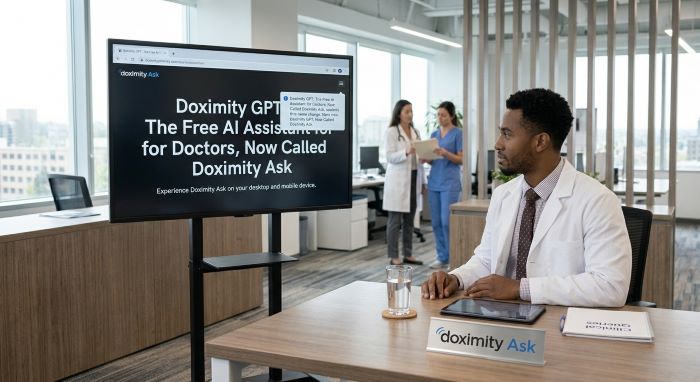
This guide explains what the tool is, how it works, what it can and can’t do, its privacy rules, its history, the legal fight with rival OpenEvidence, and how it compares to other AI tools for doctors.
What Is Doximity GPT?
Doximity GPT is a free artificial intelligence assistant built for doctors, nurse practitioners, physician assistants, pharmacists, and other clinicians in the United States. It works like a chatbot. A clinician types or dictates a question or request, and the tool replies in plain language, often with citations to medical journals.
It is made by Doximity, a San Francisco company that runs a professional network for medical workers. Doximity says it has more than 3 million registered members, including about 85% of US physicians.
The tool can help with two kinds of work:
- Clinical questions. Drug dosing, interactions, treatment options, guidelines, and summaries of research.
- Paperwork. Prior authorization letters, insurance appeal letters, referral letters, patient education handouts, and other routine documents.
It is not a doctor, and it is not meant for patients. Some people search for an “AI doctor,” but Doximity’s tool is designed to support licensed clinicians, who must check every answer before using it in care.
Quick Facts
| Detail | Information |
|---|---|
| Current name | Doximity Ask |
| Earlier names | DocsGPT (2023), Doximity GPT, DoxGPT |
| Maker | Doximity, Inc. (NYSE: DOCS) |
| Headquarters | San Francisco, California |
| Launched | Beta in February 2023 |
| Renamed | May 2026 |
| Price | Free for verified US clinicians |
| Platforms | Doximity mobile app (iOS and Android), desktop app (Mac and Windows), and doximity.com |
| Privacy | Described by Doximity as HIPAA-compliant |
| Sources | Full-text access to articles from more than 2,000 journals; over 3,200 drug monographs |
| Peer review | PeerCheck program with more than 10,000 physician reviewers |
| Key 2026 news | Renamed Ask; UpToDate partnership; OpenEvidence lawsuit settled |
A Short History
2023: DocsGPT Launches
Doximity launched DocsGPT as an open beta in February 2023, just a few months after ChatGPT went public. The first version was built on OpenAI’s ChatGPT and tuned with healthcare-specific writing. It focused on paperwork that eats up doctors’ time, such as prior authorization requests, letters of medical necessity, and insurance appeals.
The early tool was linked to Doximity’s free fax service, so doctors could draft a letter, edit it, and fax it to an insurer in one place. At first, Doximity warned users not to enter patient names or other protected health information.
2024: Becoming a Clinical Assistant
Over time, the tool grew from a letter writer into a clinical reference. Doximity added citations, faster answers, and better handling of medical questions. It also began describing the tool as HIPAA-compliant, with data encrypted and not used to train AI models.
2025: Pathway and PeerCheck
In July 2025, Doximity bought Pathway Medical, a Montreal-based AI clinical decision support company, for $63 million, including $26 million in cash and up to $37 million in equity grants. Pathway’s team and datasets were folded into Doximity’s AI tools.
Doximity also launched PeerCheck, a program in which physicians review AI answers for accuracy, strength of evidence, and bias. Cardiologist Eric Topol and former US Surgeon General Regina Benjamin serve as co-editors-in-chief.
2026: Doximity Ask and the Clinical AI Suite
In May 2026, Doximity renamed the tool Doximity Ask and grouped it with Scribe, an ambient AI notetaker, and Dialer, its patient calling tool, under a Clinical AI Suite. The old doxgpt.com address now redirects to Doximity.
In October 2026, Doximity and Wolters Kluwer announced a partnership to bring answers based on UpToDate, one of medicine’s most trusted clinical references, into Ask for health systems that subscribe to both.
Key Features
Clinical Question Answering
Clinicians can ask questions in natural language, such as the best first-line treatment for a condition or how two drugs interact. The tool returns an answer with the main conclusion first, followed by details and citations.
It offers two modes:
- Instant Mode for quick questions.
- Thinking Mode for complex cases that need deeper reasoning.
Citations and Full-Text Articles
One standout feature is access to full-text PDFs from more than 2,000 peer-reviewed journals, with no paywalls or extra logins. Answers include inline citations, so users can check the original source.
Drug Reference
Doximity built a drug reference with more than 3,200 drug monographs, covering dosing, side effects, interactions, and warnings. Drug answers are pulled from a structured, peer-reviewed dataset based on FDA labeling, rather than generated from scratch, and appear in under a second.
Paperwork and Letters
The tool’s original purpose is still one of its most popular uses. It can draft:
- Prior authorization requests
- Insurance appeal letters
- Letters of medical necessity
- Referral letters
- Patient education materials
- After-visit summaries and patient messages
Clinicians can then send documents through Doximity’s free secure fax.
Uploads and Dictation
Users can upload lab reports, imaging summaries, research papers, and clinical notes and ask questions about them. Dictation is available on desktop and mobile, which helps busy clinicians speak instead of type.
Projects and Templates
A Projects feature lets users save reusable templates and prompts for common tasks, such as a standard appeal letter for a certain drug.
PeerCheck
PeerCheck adds human review on top of AI. More than 10,000 physicians have taken part, completing tens of thousands of reviews. Answers that pass review carry a PeerCheck mark and link to the reviewers’ profiles. Doximity says this makes its answers more trustworthy than tools without physician review.
UpToDate Integration
Under the October 2026 deal, health systems that subscribe to both Doximity’s enterprise AI suite and UpToDate will see UpToDate-based answers inside Ask. This brings one of the most popular clinical references into the same tool doctors already use for paperwork and search.
Doximity GPT and HIPAA
Privacy is one of the biggest concerns for any healthcare AI tool. Doximity describes its assistant as HIPAA-compliant and secure by default. According to the company:
- Data is encrypted in transit and at rest.
- Each clinician’s sessions are private.
- Prompts are not shared or used to train AI models.
Still, clinicians should follow their own organization’s rules. Some hospitals require a business associate agreement (BAA) before staff can enter patient data into any outside system. When in doubt, users can remove names and identifiers before entering a question. Doximity’s enterprise contracts with health systems may include stronger terms.
Is It Free?
Yes. Doximity Ask is free for verified US clinicians on the Doximity app and website. Users need a Doximity account, which requires verification of their medical credentials.
Doximity earns most of its money from pharmaceutical companies and health systems that pay to reach doctors on its network through ads and hiring tools. The company has said it plans to make money from AI search through pharma marketing and enterprise deals with hospitals, not by charging individual doctors.
Health systems can buy the full Clinical AI Suite. By spring 2026, 140 health systems had bought it, including seven of the top 20 US hospitals, giving more than 250,000 prescribers access.
Who Uses It?
Doximity Ask is built for licensed US healthcare workers, including:
- Physicians and surgeons
- Nurse practitioners
- Physician assistants
- Pharmacists
- Medical residents and students
Usage has grown fast. In early 2026, Doximity said more than 300,000 unique clinicians used its AI tools in a single quarter. By its fiscal fourth quarter, it reported about 800,000 quarterly active prescribers across its platform, with almost half using clinical AI tools. Prompts per user almost doubled from January to April 2026.
What Doctors Use It For
Common uses reported by clinicians and in Doximity’s own materials include:
- Checking drug doses and interactions during a busy clinic day.
- Writing prior authorization and appeal letters to insurers, a task many doctors dread.
- Summarizing recent research on a topic before a patient visit.
- Drafting patient handouts in plain language.
- Preparing for board exams or reviewing guidelines.
- Translating medical jargon into patient-friendly words.
Several physicians have written that the tool helps them clear their inboxes faster and spend more time with patients.
Limits and Risks
Like all AI tools, it has limits:
- Errors are possible. AI can make mistakes or “hallucinate” facts. Doximity CEO Jeff Tangney has said no AI has eliminated mistakes, and every answer must be checked.
- Not for patients. The tool is meant for trained clinicians, not people seeking a diagnosis.
- US focus. Its drug data and guidelines center on US practice, which may not match other countries.
- Privacy rules vary. Clinicians must follow their employer’s policies on patient data.
- Not a replacement for judgment. The final decision always rests with the clinician.
The OpenEvidence Lawsuit
Doximity’s biggest rival in medical AI is OpenEvidence, a startup whose AI search tool is also free for clinicians and popular with doctors.
In June 2025, OpenEvidence sued Doximity, alleging that Doximity employees, including its chief technology officer and AI director, posed as physicians on OpenEvidence’s platform and used prompts to try to uncover its underlying code and models. Doximity rejected the claims and countersued in September 2025, alleging that OpenEvidence made false and harmful statements about it, including a social media chart Doximity called “deceptive.”
By fall 2025, OpenEvidence had dropped its trade secrets claims and narrowed its case. In October 2026, the two companies settled. A federal court in Massachusetts dismissed the case with prejudice, with each side paying its own legal fees. Other terms were not disclosed. None of the allegations were proven in court.
Doximity GPT vs. Other Medical AI Tools
| Tool | Maker | Price for clinicians | Key strength | Notes |
|---|---|---|---|---|
| Doximity Ask (DoxGPT) | Doximity | Free | Paperwork plus clinical answers, peer review, huge US network | UpToDate answers for joint enterprise customers |
| OpenEvidence | OpenEvidence | Free | Evidence-based answers from medical literature | Main rival |
| UpToDate Expert AI | Wolters Kluwer | Paid subscription | Trusted physician-written content | Now also inside Ask for some health systems |
| ChatGPT | OpenAI | Free and paid tiers | General-purpose AI | Not built for medicine; privacy concerns with patient data |
| Pathway | Doximity (since 2025) | Folded into Doximity | Clinical decision support | Team now part of Doximity |
In a company-published analysis of more than 1,300 physicians, Doximity said its tool was chosen as the best answer 61% of the time when a preference was given, compared with 26% for OpenEvidence. Because Doximity ran the study, these results should be read with care.
How to Get Started
Using the tool takes just a few steps:
- Create a Doximity account at doximity.com or in the Doximity app.
- Verify your credentials. Doximity confirms that you are a licensed clinician or student.
- Open Ask from the app menu or the website.
- Type or dictate a question or choose a template, such as a prior authorization letter.
- Review the answer and citations before using any information in care.
- Edit and send documents through Doximity’s secure fax if needed.
For a closer look at the latest features, see Doximity’s own overview of what’s new with DoxGPT, which explains the drug reference, journal access, and privacy settings.
Doximity the Company
Doximity was founded in 2010 by Jeff Tangney, who also co-founded the medical reference app Epocrates. The company went public on the New York Stock Exchange in 2021 under the ticker DOCS.
Its main products include:
- A professional networking platform for clinicians
- Free telehealth video and voice calls through Doximity Dialer
- Secure fax and messaging
- Medical news and continuing education
- Hiring tools for hospitals
- The Clinical AI Suite: Ask, Scribe, and Dialer
In its fiscal third quarter of 2026, Doximity reported revenue of $185 million, up 10% from a year earlier. Its shares fell hard after soft guidance, as the company said it would invest big in AI. Management called 2026 an “AI investment year,” with more spending on research, computing power, marketing, and physician peer review.
Doximity also signed partnerships with Aledade, a network serving more than 3,000 primary care organizations, to bring Ask and Scribe into Aledade’s tools, and with Photon Health to offer free e-prescribing inside Doximity.
Doximity GPT Healthcare Impact
Many doctors spend hours a week on paperwork, and studies have linked this burden to burnout. Tools like Doximity’s assistant aim to cut that time. By drafting letters in seconds and answering clinical questions with sources, the tool gives clinicians more time for patients.
At the same time, healthcare experts warn that AI must be used with care. Errors in medicine can harm patients, so human review remains essential. Doximity’s PeerCheck program and its partnership with UpToDate show how the company is trying to blend AI speed with expert-checked content.
The Future of Doximity Ask
Doximity has said it plans to release new physician-led features and AI “agents” that can handle multi-step tasks. Likely areas include deeper links to electronic health records, smarter prior authorization tools, and more peer-reviewed answers. The company also plans to make money from AI through pharma advertising and enterprise deals, while keeping the tool free for individual clinicians.
With its huge physician network, free access, and new partnerships, Doximity is betting that its AI assistant can become the default tool doctors open every day.
Final Thoughts
Doximity GPT started as a simple helper for writing insurance letters and has become one of the most popular AI tools in American medicine. Now called Doximity Ask, it offers clinical answers with citations, a large drug reference, full-text journal access, physician peer review, and soon UpToDate content for many health systems. It is free for verified US clinicians and described by Doximity as HIPAA-compliant.
For doctors, it can save time and reduce paperwork, but it is not a replacement for clinical judgment. For patients, it is not an “AI doctor” for patients to consult. Used with care, it shows how AI can support, rather than replace, the people who deliver care.
Key Takeaways
- Doximity GPT, also called DoxGPT, launched as DocsGPT in February 2023 and was renamed Doximity Ask in May 2026.
- It is a free AI assistant for verified US clinicians, available on the Doximity app and website.
- It answers clinical questions with citations and drafts prior authorizations, appeals, and patient materials.
- Doximity describes it as HIPAA-compliant, with encrypted data that isn’t used to train AI models.
- PeerCheck adds review by more than 10,000 physicians, led by Eric Topol and Regina Benjamin.
- Doximity bought Pathway for $63 million in 2025 and partnered with Wolters Kluwer to bring UpToDate into Ask in 2026.
- OpenEvidence and Doximity settled their legal fight in October 2026, with no allegations proven in court.
- The tool supports clinicians but is not meant for patients seeking medical advice.