

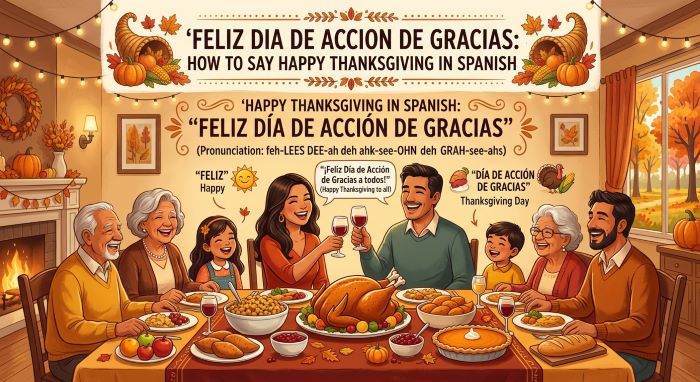
Feliz Dia de Accion de Gracias: How to Say Happy Thanksgiving in Spanish
Maybe your partner’s family speaks Spanish at the dinner table. Maybe you have a coworker from Mexico, a neighbor from Puerto Rico, or a group chat full of cousins in Texas. Either way, you want to wish them a happy Thanksgiving in their language, and you want to get it right. The phrase you need is feliz dia de accion de gracias.
This guide breaks down what the phrase means, how to pronounce it, how to spell it with the right accents, and how to turn it into a warm message for anyone on your list. You will also find other ways to say it, a short list of holiday vocabulary, and a few tips that help you sound natural instead of textbook.
What Does Feliz Dia de Accion de Gracias Mean?
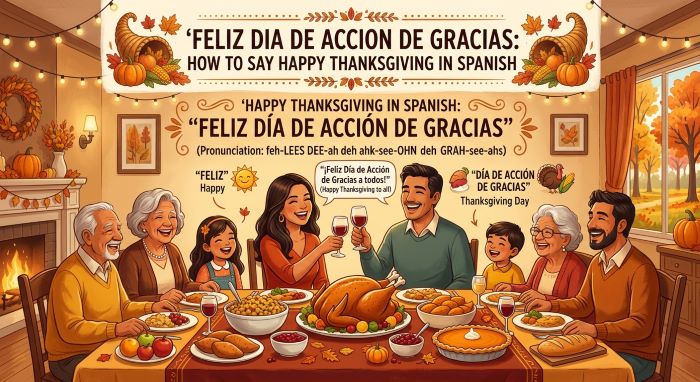
In plain English, feliz dia de accion de gracias means “Happy Thanksgiving Day.” The literal translation is a bit longer, and it helps to see each word on its own.
| Spanish Word | Literal Meaning |
|---|---|
| Feliz | Happy |
| Día | Day |
| de | of |
| Acción | Action |
| de | of |
| Gracias | Thanks |
Put together, the word-for-word version reads “Happy Day of Action of Thanks.” That sounds odd in English, but in Spanish it works. “Acción de gracias” is an old phrase for the act of giving thanks, often in a religious sense. So the holiday’s Spanish name points to the idea of thanking someone, not just the meal.
How to Pronounce It
Spanish is close to phonetic, so once you know the sounds, you can say the whole phrase with confidence. Here is a simple breakdown:
- Feliz: feh-LEES
- Día: DEE-ah
- de: deh
- Acción: ahk-SYOHN
- de: deh
- Gracias: GRAH-syahs
Say it all together: feh-LEES DEE-ah deh ahk-SYOHN deh GRAH-syahs.
A few notes:
- In most of Latin America, the “z” in feliz and the “c” in gracias sound like an English “s.”
- In much of Spain, those same letters sound like the “th” in “think.” So you may hear “feh-LEETH” and “GRAH-thyahs” from someone from Madrid.
- The double “c” in acción makes two sounds: a “k” and then an “s.”
- Roll the “r” in gracias if you can. A light tap is fine if you can’t.
Spelling It the Right Way
When people search online, they often type feliz dia de accion de gracias with no accent marks. That’s fine for a search bar. In a card, a text to your mother-in-law, or a social post, the correct spelling looks like this:
¡Feliz Día de Acción de Gracias!
Three details make the difference:
- Accent on Día. The mark over the “i” shows where the stress falls.
- Accent on Acción. The stress lands on the last syllable, so it needs the mark.
- Inverted exclamation mark. Spanish opens an exclamation with “¡” and closes it with “!”.
Capital letters on the main words of the holiday name are the standard choice, since it is the name of a holiday. If you are typing on a phone, press and hold a letter to find the accented version. On a computer, most keyboards have a Spanish layout you can switch on in settings.
Other Ways to Say Happy Thanksgiving in Spanish
The full phrase is the most common, but it’s not the only option. Native speakers shorten it all the time, the same way English speakers say “Happy Turkey Day.”
- ¡Feliz Acción de Gracias! Drops the word “día.” Short and common in casual texts.
- ¡Feliz Día de Gracias! A shorter version you will hear in Puerto Rico and among some families in the US.
- ¡Felices fiestas de Acción de Gracias! “Happy Thanksgiving holidays.” Good when you mean the whole long weekend.
- ¡Que pases un feliz Día de Acción de Gracias! “I hope you have a happy Thanksgiving.” Friendly and personal.
- ¡Les deseo un feliz Día de Acción de Gracias! “I wish you all a happy Thanksgiving.” Works for a group or a family.
Thanksgiving Messages in Spanish (With Translations)
A short greeting is great, but a full message feels more personal. Here are ready-to-use lines grouped by who you are writing to. Copy them, change a word or two, and they are yours.
For Family
- Feliz Día de Acción de Gracias. Doy gracias por tenerlos en mi vida. Happy Thanksgiving. I’m thankful to have you in my life.
- Hoy y siempre, mi familia es mi mayor bendición. Today and always, my family is my greatest blessing.
- Que esta mesa siempre esté llena de amor y risas. May this table always be full of love and laughter.
For Friends
- Gracias por estar a mi lado este año. ¡Feliz Acción de Gracias! Thanks for being by my side this year. Happy Thanksgiving!
- Que disfrutes el pavo, la familia y una buena siesta. Enjoy the turkey, the family, and a good nap.
- Tengo mucho que agradecer, y tú estás en la lista. I have a lot to be thankful for, and you’re on the list.
For Coworkers or Clients
- Le deseo un feliz Día de Acción de Gracias a usted y a su familia. I wish you and your family a happy Thanksgiving.
- Gracias por su confianza y apoyo este año. Thank you for your trust and support this year.
- Que disfrute de un merecido descanso con sus seres queridos. Enjoy a well-earned break with your loved ones.
Faith-Based Messages
- Damos gracias a Dios por todas sus bendiciones. We give thanks to God for all His blessings.
- Que Dios bendiga tu hogar en este Día de Acción de Gracias. May God bless your home this Thanksgiving.
Light and Funny
- Mi plan para hoy: comer, dormir, repetir. My plan for today: eat, sleep, repeat.
- Doy gracias por el pastel de calabaza. Y por ti, claro. I’m thankful for pumpkin pie. And for you, of course.
Tú or Usted? Picking the Right Tone
Spanish has two ways to say “you.” Choosing the right one matters more than perfect grammar.
- Tú is informal. Use it with friends, siblings, cousins, and people your age.
- Usted is formal. Use it with your boss, clients, older relatives you don’t know well, or your partner’s grandparents on a first meeting.
- Ustedes is plural “you.” In Latin America, it works for any group, formal or casual.
If you’re not sure, start with usted. Nobody gets offended by too much respect, and people will tell you if they want you to switch.
Who Celebrates Thanksgiving in Spanish?
Thanksgiving is a North American holiday, so most Spanish-speaking countries don’t celebrate it. Still, the phrase feliz dia de accion de gracias gets a lot of use in a few places.
- The United States. Millions of Spanish-speaking families celebrate Thanksgiving. Many blend the classic turkey dinner with their own dishes, like tamales, arroz con gandules, or pernil.
- Puerto Rico. As a US territory, Puerto Rico observes Thanksgiving as an official holiday. Some families roast a turkey seasoned like pernil, a dish locals call “pavochón.”
- Canada. Canadian Thanksgiving falls on the second Monday in October, and Spanish-speaking communities there use the same greeting.
In 2026, US Thanksgiving falls on Thursday, November 26. That gives you a few weeks to practice your greeting before the big meal.
Useful Thanksgiving Vocabulary
Want to go beyond the greeting? These words come up at almost every Spanish-speaking Thanksgiving table.
| Spanish | English |
|---|---|
| El pavo | Turkey |
| El relleno | Stuffing |
| El puré de papas | Mashed potatoes |
| La salsa de arándanos | Cranberry sauce |
| El pastel de calabaza | Pumpkin pie |
| La cena | Dinner |
| La cosecha | Harvest |
| Agradecido / Agradecida | Thankful (male / female) |
| La sobremesa | Time spent talking at the table after a meal |
| Los seres queridos | Loved ones |
“Sobremesa” is a great word to know. There’s no single English word for it, and it fits Thanksgiving well, since the best part of the day is often the long conversation after everyone finishes eating.
A Simple Phrase to Share at the Table
If your hosts go around the table sharing what they’re thankful for, try this:
Estoy agradecido (or agradecida) por… means “I am thankful for…”
Finish it with something simple: mi familia (my family), mi salud (my health), or esta comida (this food). It’s short, easy to say, and it shows real effort.
Tips for Sounding Natural
A few small habits make your Spanish feel warm instead of stiff:
- Keep it short. A clear “¡Feliz Día de Acción de Gracias!” beats a long sentence full of mistakes.
- Add a name. “¡Feliz Acción de Gracias, Tía Rosa!” feels personal right away.
- Match the gender. Women say “agradecida” and men say “agradecido.”
- Don’t stress the accent marks in speech. They matter in writing. Out loud, just put the stress in the right place.
- Try it, even if you’re nervous. Native speakers almost always appreciate the effort more than they notice small errors.
Wrapping Up
Wishing someone feliz dia de accion de gracias is a small gesture, but it lands. It tells your Spanish-speaking friends, coworkers, or in-laws that you took a moment to meet them in their language. You now know what the phrase means, how to say it, how to write it with the right accents, and how to turn it into a message that fits the person you’re writing to.
Pick one or two lines from this guide, practice them out loud a few times, and use them this November. A simple feliz dia de accion de gracias, said with a smile, can start a great conversation at the table.
Key Takeaways
- Feliz dia de accion de gracias means “Happy Thanksgiving Day” in Spanish. The literal translation is “Happy Day of Action of Thanks.”
- Pronounce it feh-LEES DEE-ah deh ahk-SYOHN deh GRAH-syahs. In Spain, the “z” and “c” sounds shift to a soft “th.”
- The correct written form is ¡Feliz Día de Acción de Gracias!, with accents on Día and Acción and an inverted exclamation mark at the start.
- Shorter versions like ¡Feliz Acción de Gracias! and ¡Feliz Día de Gracias! are common in casual texts and conversation.
- Use tú with friends and family your age, and usted with bosses, clients, and older relatives you don’t know well.
- Spanish speakers who celebrate Thanksgiving live in the United States, Puerto Rico, and Canada. US Thanksgiving 2026 falls on Thursday, November 26.
- Learning a few table words like pavo, relleno, and sobremesa, plus the phrase “Estoy agradecido/agradecida por…”, helps you join the conversation beyond the greeting.