Mark Zuckerberg and Sundar Pichai
Two of the most powerful people in tech run companies that compete for almost everything: your attention, advertising dollars, top AI researchers, and the future of artificial intelligence. Mark Zuckerberg leads Meta, the company behind Facebook, Instagram, and WhatsApp. Sundar Pichai leads Google and its parent company, Alphabet.
Mark Zuckerberg and Sundar Pichai took very different paths to the top. Zuckerberg founded his company in a Harvard dorm room at 19. Pichai grew up in a two-room apartment in India and rose through Google’s ranks over a decade. In 2026, both are pouring huge sums into AI, racing to build smarter systems. This article looks at their lives, careers, and rivalry.
Quick Facts
| Detail | Mark Zuckerberg | Sundar Pichai |
|---|---|---|
| Born | May 14, 1984, White Plains, New York | June 10, 1972, Madurai, India |
| Age in 2026 | 42 | 54 |
| Education | Phillips Exeter Academy; attended Harvard University | B.Tech, IIT Kharagpur; MS, Stanford; MBA, Wharton |
| Role | Founder, chairman, and CEO of Meta | CEO of Google and Alphabet |
| Path to CEO | Founded the company | Rose through the ranks |
| AI focus | “Personal superintelligence” | Gemini models across Google products |
Mark Zuckerberg: The Founder
Early Life and Education
Mark Elliot Zuckerberg grew up in Dobbs Ferry, New York. His father was a dentist and his mother a psychiatrist. He started coding as a kid and built a messaging program for his father’s dental office. He attended Phillips Exeter Academy, a prestigious boarding school, then enrolled at Harvard to study computer science and psychology.
Career Timeline
- 2004: Launched “TheFacebook” from his Harvard dorm room. He left Harvard later that year to run it full time.
- 2006: Opened Facebook to anyone over 13 with an email address.
- 2012: Took Facebook public and bought Instagram for $1 billion.
- 2014: Bought WhatsApp for about $19 billion and Oculus for about $2 billion.
- 2015: Pledged with his wife, Priscilla Chan, to give away 99 percent of their Facebook shares through the Chan Zuckerberg Initiative.
- 2017: Received an honorary degree from Harvard and gave its commencement speech.
- 2018: Testified before Congress after the Cambridge Analytica data scandal.
- 2021: Renamed the company Meta to focus on the metaverse.
- 2023: Released the Llama AI models as open source.
- 2025: Launched Meta Superintelligence Labs and hired top AI researchers with large pay packages.
- 2026: Planned up to about $135 billion in spending, much of it for AI data centers, and published his vision that superintelligence should be available to everyone.
Sundar Pichai: The Rise Through the Ranks
Early Life and Education
Pichai Sundararajan grew up in Chennai, India, in a modest home. His father was an electrical engineer, and his mother was a stenographer before raising her children. The family had no TV or car for years, and Pichai has said the arrival of a rotary phone changed his life.
He studied metallurgical engineering at IIT Kharagpur, earned a master’s degree in materials science from Stanford, and later received an MBA from the Wharton School.
Career Timeline
- Late 1990s to early 2000s: Worked in engineering at Applied Materials and as a management consultant at McKinsey.
- 2004: Joined Google to work on its search toolbar.
- 2008: Led the launch of the Chrome browser, which became the world’s most popular.
- 2013: Took over Android, the world’s most-used mobile operating system.
- 2015: Became CEO of Google when Alphabet was formed.
- 2019: Became CEO of Alphabet as well, after co-founders Larry Page and Sergey Brin stepped back.
- 2022: Received the Padma Bhushan, one of India’s highest civilian honors.
- 2023 onward: Led Google’s push into generative AI, launching the Gemini models.
- 2026: Delivered the commencement speech at Stanford University and continued to expand Gemini across Search, Android, and Workspace.
Founder vs. Operator
The biggest difference between Mark Zuckerberg and Sundar Pichai is how they got to the top.
| Leadership Trait | Mark Zuckerberg | Sundar Pichai |
|---|---|---|
| Role origin | Founder with voting control | Professional manager chosen by founders |
| Style | Bold bets, fast moves | Calm, consensus-driven |
| Public image | Polarizing, high-profile | Low-key, diplomatic |
| Big bets | Metaverse, open-source AI | Chrome, Android, Gemini |
| Control | Holds majority voting power at Meta | Answers to a board led by founders’ influence |
Zuckerberg can make huge bets, like renaming his company and spending tens of billions on the metaverse, because he controls Meta’s voting shares. Pichai leads with a steadier hand, building products that reach billions while balancing many teams and interests.
The AI Race
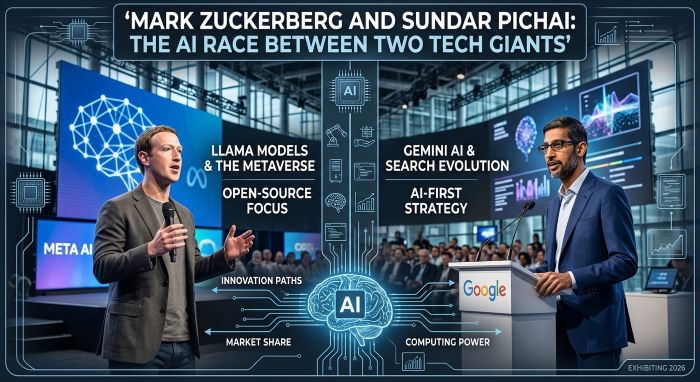
In 2026, AI is the main battlefield between Meta and Google.
Zuckerberg has pushed for what he calls “personal superintelligence,” AI that helps each person with their own goals. Meta’s Llama models were released openly, which Zuckerberg says lets more people build on them.
Pichai has made Gemini the center of Google’s strategy. Gemini powers features in Search, Gmail, Android, and Google’s cloud business. Google also owns DeepMind, one of the world’s top AI research labs.
Both companies are spending record sums on data centers, chips, and talent. Supporters say this investment will bring powerful new tools. Critics worry about costs, energy use, and how much power a few companies hold over AI.
Why People Compare Them
Searches for Mark Zuckerberg and Sundar Pichai often come from readers following the battle for AI leadership. Both appear in nearly every story about the future of tech, and both have testified before Congress on privacy, competition, and online safety.
Their life stories also make a striking contrast. Mark Zuckerberg and Sundar Pichai represent two versions of the tech dream: the young founder who builds a company from nothing, and the immigrant engineer who rises step by step to lead one of the world’s most valuable companies.
Giving Back
- Zuckerberg and Priscilla Chan run the Chan Zuckerberg Initiative, which funds science research, including the Biohub network focused on curing disease.
- Pichai has supported education and tech access programs, including Google’s efforts to train people in digital skills in India and around the world.
Facing Regulators
Both leaders have spent a lot of time answering to governments.
Zuckerberg has testified before Congress several times, on topics from data privacy to election interference and child safety online. Meta has also faced antitrust challenges, including a US government case over its purchases of Instagram and WhatsApp.
Pichai has testified before Congress as well, on search bias, privacy, and competition. Google has faced major antitrust cases in the US and Europe over its search and advertising businesses, with courts ruling against the company in some cases.
For Mark Zuckerberg and Sundar Pichai, managing these legal and political battles is now as much a part of the job as building products. How they handle regulators will shape the future of both companies, especially as governments around the world write new rules for AI.
Leadership Lessons
Mark Zuckerberg and Sundar Pichai show two different ways to lead a tech giant. Zuckerberg proves that a founder’s vision and control can enable huge, risky bets. Pichai proves that a patient, collaborative leader can guide a massive company through change without drama. Both styles have produced enormous companies, which suggests there’s more than one way to lead in tech.
Final Thoughts
Mark Zuckerberg and Sundar Pichai lead two of the most influential companies on the planet. Zuckerberg built Meta from a dorm room and still runs it as founder. Pichai rose from a modest home in Chennai to lead Google and Alphabet. In 2026, both are betting their companies’ futures on AI.
Whoever leads the AI race, these two leaders will shape how billions of people search, connect, and work for years to come.
Key Takeaways
- Mark Zuckerberg was born May 14, 1984, in New York. Sundar Pichai was born June 10, 1972, in Madurai, India.
- Mark Zuckerberg and Sundar Pichai lead rival tech giants, Meta and Google, competing for ads, users, and AI leadership.
- Zuckerberg left Harvard to run Facebook, which he launched in 2004 and renamed Meta in 2021.
- Pichai studied at IIT Kharagpur, Stanford, and Wharton, joined Google in 2004, and became CEO in 2015.
- In 2026, Meta planned up to about $135 billion in spending, much of it on AI, while Google expanded its Gemini models.
- Zuckerberg is a founder with voting control, while Pichai is a professional manager who rose through the ranks.
- Both give back, through the Chan Zuckerberg Initiative and education and digital skills programs.