

Research Dossier for Target Company
Most meetings go wrong before anyone sits down. The salesperson pitches a product the buyer replaced last quarter. The candidate asks a question the annual report answers on page two. The investor learns about a lawsuit from the other side of the table. A research dossier for target company work exists to stop those moments. It puts what you need to know about one business into a single document you can read in ten minutes.
This guide shows what goes into one, where to find the facts, and how to build it fast without filling it with noise.
What a Company Dossier Is
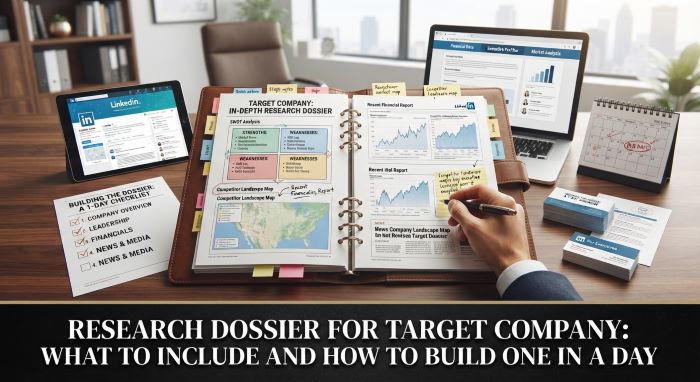
A research dossier for target company analysis is a structured file on one organization. It collects facts from public sources, sorts them into sections, and ends with a short view on what they mean for you.
It is not a data dump. A folder with forty saved links is not a dossier. The value comes from selection: you pick the twenty facts that matter and leave out the two hundred that do not.
A good one answers five questions:
- What does this company do, and how does it make money?
- Who runs it, and who decides?
- How is it doing right now?
- What is changing for it?
- What does all of this mean for my goal?
Who Needs a Research Dossier for Target Company Work
The format stays the same across jobs. The emphasis shifts.
- Sales and account teams use it to find the right buyer, the right timing, and the pain worth talking about.
- Investors and analysts use it to test a thesis before they spend hours on a model.
- M&A and corporate development teams use it as the first screen before formal due diligence.
- Job seekers use it to prepare for interviews and to judge whether the employer is stable.
- Partnership and procurement teams use it to check a supplier or partner before they sign.
- Journalists and researchers use it as background before interviews.
Decide which of these you are before you start. The goal sets the depth of every section.
The Core Sections
Every dossier target company file should cover the same eight blocks. Keep each one short.
1. Snapshot
One paragraph and a small table: legal name, headquarters, founding year, ownership type, employee count, revenue range, and main markets. A reader should grasp the size and shape of the business in thirty seconds.
2. Business Model
What it sells, to whom, and how it charges. Note the main product lines and which ones drive revenue. If the company reports segments, list them with their share of sales.
3. Financial Health
For public companies: revenue and profit trend over three years, cash, debt, and the last guidance. For private companies: funding rounds, investors, last known valuation, and any filed accounts. Flag gaps as gaps. Do not guess.
4. Leadership and Decision Makers
The chief executive, the finance lead, and the heads of the functions you care about. Add tenure and prior roles. New leaders often bring new vendors and new priorities, so note any change in the last twelve months.
5. Strategy and Recent Moves
What the company says it will do, and what it has done. Use the last annual report, earnings calls, and press releases. List acquisitions, product launches, layoffs, new offices, and big hires with dates.
6. Market and Competitors
The three to five rivals that matter, with one line on how the target differs from each. Add the main trends that help or hurt the sector.
7. Risks and Red Flags
Lawsuits, regulatory action, customer concentration, debt due soon, executive exits, security incidents, and poor employee reviews. This section earns its keep. It is the one people skip and later regret.
8. Your Angle
Five lines at most. What should you do with this information? For a sales team, that means the opening message and the likely objection. For an investor, the key question to answer next. For a candidate, three smart questions to ask.
Where to Find Reliable Information
A research dossier for target company decisions is as good as its sources. Stick to ones you can cite. Each claim in the file should trace back to one.
Company sources
- Website, product pages, and pricing pages
- Annual reports and investor presentations
- Press releases and the company blog
- Job postings, which reveal tools, plans, and growing teams
Official filings
- SEC filings for US public companies, above all the 10-K, 10-Q, and proxy statement
- Companies House for UK firms, and the matching registry in other countries
- Court records and regulator databases
- Patent and trademark databases
Third-party sources
- Business news and trade press
- Earnings call transcripts
- Funding databases such as Crunchbase or PitchBook
- LinkedIn for headcount trends and career histories
- Customer review sites and employee review sites
- Industry analyst reports
Your own sources
- CRM notes and past emails
- Colleagues who have worked with or at the company
- Conversations with customers, suppliers, or former staff, within the limits of what they can share
Rank them. A filing beats a press release. A press release beats a news story. A news story beats a forum post.
How to Build One Step by Step
You can finish a solid research dossier for target company use in three to five hours if you follow a fixed order.
- Write the goal at the top. One sentence. “Prepare for a first sales call with the head of operations” or “Decide whether to open talks about an acquisition.”
- Fill the snapshot first. It takes twenty minutes and stops you from drifting.
- Read the latest annual report or funding news. This gives you the model, the numbers, and the stated plan in one pass.
- Scan twelve months of news. Sort by date. Note events, not opinions.
- Map the people. Build a short table of names, roles, tenure, and source links.
- Check for trouble. Search the company name with terms such as “lawsuit,” “fine,” “breach,” “layoffs,” and “recall.”
- Size up three competitors. One line each.
- Write your angle last. Read your notes, then state what they mean.
- Cite and date. Put a source next to each fact and a date at the top of the file.
Set a time limit for each step. Research expands to fill the day if you let it.
A Simple Template
Copy this structure into a document or a notes tool.
| Section | What to capture | Target length |
|---|---|---|
| Goal | Why you are researching this company | 1 sentence |
| Snapshot | Name, HQ, size, ownership, revenue range | 1 short table |
| Business model | Products, customers, pricing, segments | 5 bullets |
| Financial health | Trend, cash, debt, funding | 5 bullets |
| Leadership | Names, roles, tenure, recent changes | 1 table |
| Strategy and moves | Stated plans, deals, launches, hires | 6 dated bullets |
| Market | Top rivals and sector trends | 5 bullets |
| Risks | Legal, financial, people, reputation | 5 bullets |
| Your angle | What to do next | 5 lines |
| Sources | Links with access dates | List |
Two pages is a good cap. If a section runs long, move the detail to an appendix.
How Depth Changes by Use Case
A dossier target company file for a sales call does not need the same depth as one for a merger.
- Sales: go deep on leadership, recent moves, and tech stack. Go light on financial detail. Look for trigger events such as a new executive, a funding round, or a product launch.
- Investing: go deep on financial health, unit economics, competitors, and risks. Note what the market seems to believe and where you differ.
- M&A screening: go deep on ownership, cap table, customer concentration, contracts, and culture. Treat the file as a first filter, not a replacement for due diligence with lawyers and accountants.
- Job interviews: go deep on strategy, the team you would join, and recent news. Add notes on the interviewers.
- Supplier checks: go deep on stability, legal history, and delivery record.
Tools That Speed Up the Work
You do not need paid software to build a research dossier for target company review. A few tools help:
- Search alerts send you new mentions of the company name.
- Filing search tools let you search inside reports for words such as “risk,” “customer,” or “competition.”
- AI assistants can summarize long reports and draft the first version of each section. Check every figure against the source. Models can state wrong numbers with full confidence.
- A shared template keeps each dossier target company record in the same format, so your team can compare accounts side by side.
- A CRM or notes database stores the files where others can find and update them.
Mistakes That Weaken a Dossier
The same errors show up in almost every weak research dossier for target company work.
- Collecting without a goal. You end up with trivia.
- Trusting one source. Cross-check key facts, above all revenue, headcount, and leadership names.
- Using stale data. A leadership table from two years ago can send your message to someone who left.
- Mixing fact and opinion. Mark your own inferences as inferences.
- Skipping the risk section. Good news is easy to find. Bad news takes one more search.
- Writing too much. If nobody reads past page one, the rest did not help.
- Leaving out sources. A fact with no link cannot be checked or updated.
Keeping It Legal and Ethical
Use public information and information people share with you in the open. Do not pose as someone else to get details. Do not ask a new hire for a former employer’s confidential files. Respect privacy law when you store notes on named people, and keep those notes to professional facts. If you would not be comfortable showing the company your file, look again at how you built it.
When to Update It
A dossier ages fast. Refresh it:
- Before any major meeting
- After earnings or a funding round
- When a senior leader joins or leaves
- After an acquisition, a large layoff, or a lawsuit
- At least once a quarter for active accounts
Put the last review date at the top. A reader should know how far to trust it at a glance.
Key Takeaways
- A research dossier for target company work is a short, structured file that tells you what a business does, who runs it, how it is doing, what is changing, and what that means for your goal.
- Start with one sentence that states why you are doing the research. The goal decides how deep each section goes.
- Cover eight blocks: snapshot, business model, financial health, leadership, strategy and recent moves, market, risks, and your angle.
- Rank your sources. Official filings and company reports come first, then news and trade press, then databases and review sites.
- Follow a fixed order and set a time limit per step. Three to five hours is enough for a strong first version.
- Keep it to about two pages, cite each fact, and date the file.
- Adjust depth by use: people and trigger events for sales, numbers and risks for investing, ownership and contracts for M&A, strategy and team for interviews.
- Never skip the risk section, and never present a guess as a fact.
- Use public and information people share in the open, and refresh the file before big meetings and after major company events.