

What Is Triamcinolone Cream 0.1 Used to Treat?
You leave the pharmacy with a small white tube, a label full of fine print, and a rash that still itches. The first question most people type into a search bar is simple: what is triamcinolone cream 0.1 used to treat? The short version is that it calms inflamed, itchy skin. The longer version matters more, because this cream helps some rashes a great deal and makes others worse.
This guide walks through the conditions it treats, the ones it should stay away from, how to apply it, and when to call your doctor. It is general information, not a replacement for the advice of the person who wrote your prescription.
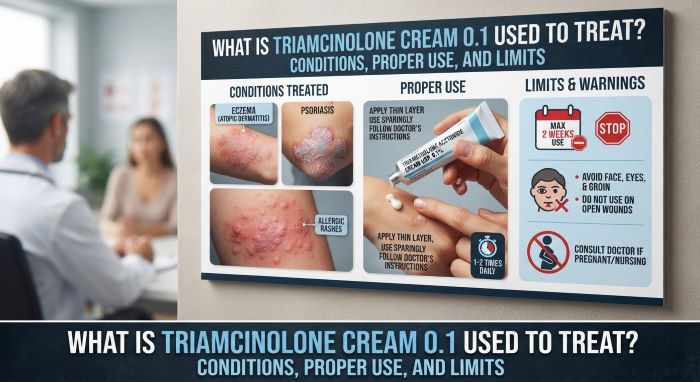
What Is Triamcinolone Cream 0.1 Used to Treat? The Short Answer
Triamcinolone acetonide is a topical corticosteroid, which most people call a steroid cream. The FDA label says it relieves the inflammation and itching of “corticosteroid-responsive dermatoses.” In plain English, that means skin conditions that improve when you turn down the local immune response.
The most common ones are:
- Eczema (atopic dermatitis): dry, red, itchy patches that flare and settle
- Contact dermatitis: rashes from poison ivy, poison oak, nickel, fragrances, or harsh soaps
- Psoriasis: thick, scaly plaques, often on elbows, knees, and the trunk
- Seborrheic dermatitis: flaky, red patches on oily areas of the body
- Allergic skin reactions: including strong reactions to insect bites
- Lichen planus and lichen simplex: itchy, thickened, or bumpy patches
- Discoid lupus: coin-shaped inflamed patches, under a specialist’s care
Notice what these have in common. None of them is an infection. In each case the skin itself is overreacting, and the cream quiets that reaction.
How the Cream Works
Your immune system sends chemical signals to irritated skin. Those signals widen blood vessels, bring in immune cells, and trigger the redness, swelling, heat, and itch you feel. Triamcinolone slips into skin cells and tells them to produce fewer of those signals.
The result:
- Blood vessels in the area narrow, so redness fades.
- Swelling goes down.
- The itch eases, which breaks the scratch and flare cycle.
- The skin barrier gets time to repair itself.
The cream does not cure eczema or psoriasis. It controls a flare. That distinction shapes how doctors prescribe it: short bursts during flares, then a break.
Where 0.1% Sits on the Strength Scale
Topical triamcinolone comes in several strengths, from 0.025% up to 0.5%. The 0.1% cream sits in the middle. Dermatologists rank topical steroids in potency classes, and this one lands in the medium range.
That middle position explains why it is so common, and it shapes the answer to what is triamcinolone cream 0.1 used to treat. Over-the-counter hydrocortisone 1% is often too weak for a stubborn flare. High-potency steroids like clobetasol carry more risk and suit thick skin for short periods. The 0.1% strength handles most body rashes without the risks of the strongest options.
Each gram contains 1 mg of triamcinolone acetonide. In the United States you need a prescription for it.
The base matters too. Cream is lighter than ointment, rubs in without a greasy film, and works well on moist or weeping rashes and skin folds. Ointment holds more moisture and suits dry, thick, scaly patches. If your doctor picked the cream, the type of rash is often the reason.
What It Does Not Treat
Here is the part many articles skip. When people ask what is triamcinolone cream 0.1 used to treat, the honest answer includes a list of things it should not touch.
- Fungal infections: ringworm, athlete’s foot, and jock itch. A steroid calms the redness for a few days while the fungus spreads underneath. The rash then returns larger and harder to diagnose.
- Bacterial infections: impetigo, infected cuts, and boils need antibiotics, not a steroid.
- Viral infections: cold sores, shingles, chickenpox, and warts.
- Acne: steroids can trigger more breakouts.
- Rosacea and perioral dermatitis: steroid creams tend to worsen both, with a rebound flare when you stop.
- Diaper rash: unless a pediatrician says otherwise. A diaper acts like a tight covering and drives more drug into the skin.
Doctors do pair triamcinolone with an antifungal in some combination products. That is a decision for a prescriber, not a home experiment with a leftover tube.
So the full answer to what is triamcinolone cream 0.1 used to treat is this: inflammation, not germs. If a rash is spreading in a ring, oozing yellow crust, or blistering in a band on one side of the body, get it checked before you apply anything.
How to Apply It
MedlinePlus sums up the method in one line: apply a thin film and rub it in with light pressure. More cream does not mean faster healing. It means more drug absorbed and more risk.
A simple routine:
- Wash and dry the affected area.
- Squeeze out a small amount. A strip from the fingertip to the first joint covers an area about the size of two adult palms.
- Spread a thin layer over the rash only, not the healthy skin around it.
- Rub it in until it disappears.
- Wash your hands, unless your hands are the treated area.
The label for the 0.1% cream calls for two to three applications a day. Your prescription may say something different, and your prescription wins.
A few more rules worth following:
- Do not wrap or bandage the area unless your doctor tells you to. Covering the skin increases absorption.
- Keep it out of your eyes, nose, and mouth.
- If you use a moisturizer, ask your pharmacist about the order and timing. Many suggest spacing the two apart.
- If you miss a dose, apply it when you remember. Skip it if the next dose is close. Do not double up.
Where on the Body to Be Careful
Skin thickness varies a lot across the body, and thin skin absorbs far more steroid. That is why the same cream that suits your forearm can cause trouble on your eyelids.
Use extra caution, and only with your doctor’s direction, on:
- The face, above all the eyelids
- The groin and genitals
- The armpits
- Skin folds under the breasts or belly
On these areas, doctors often choose a weaker steroid or limit triamcinolone to a few days.
How Long You Can Use It
Most flares improve within a few days. Many prescribers limit continuous use to about two weeks, then reassess. If the rash looks the same after that time, the diagnosis may be wrong, or you may need a different treatment.
For chronic conditions like eczema or psoriasis, doctors often set a pattern: use the cream during a flare, stop when the skin clears, and rely on moisturizers in between. Follow the schedule you were given. Do not stretch one tube across months of daily use.
Side Effects to Know About
Most people who use the cream as directed for a short time have no problems. The common reactions are mild and happen at the application site:
- Burning or stinging
- Itching
- Dryness
- Irritation or redness
Longer use, heavy use, or use on thin skin raises the odds of these:
- Skin thinning that makes the area fragile and easy to bruise
- Stretch marks
- Lighter or darker patches
- Small acne-like bumps or bumps around hair follicles
- Extra hair growth in the treated area
- Visible tiny blood vessels
Large amounts absorbed through the skin can affect the whole body. This is rare with normal use. The risk climbs when you treat large areas, use the cream for a long time, or cover it with bandages. Steroids absorbed this way can suppress your adrenal glands and raise blood sugar, so people with diabetes should mention it to their doctor.
Stop the cream and get medical help for hives, facial swelling, trouble breathing, or a rash that gets much worse after you apply it. Those point to an allergic reaction.
Children, Pregnancy, and Breastfeeding
Children have more skin surface relative to their body weight, so they absorb more of the drug. MedlinePlus warns that children who use topical triamcinolone may face a higher risk of side effects, including slowed growth and delayed weight gain. Pediatricians keep the course short and the amount small.
If you are pregnant, planning a pregnancy, or breastfeeding, tell your doctor before you start. If you are breastfeeding and cleared to use it, keep the cream off the breast area so the baby does not swallow it.
When to Call Your Doctor
Check in if:
- The rash has not improved after the time your doctor specified
- The area turns warm, swollen, painful, or starts to ooze
- The rash spreads beyond where it started
- You notice thinning skin, stretch marks, or color changes
- The rash comes back worse each time you stop
Bring the tube with you. Knowing what is triamcinolone cream 0.1 used to treat helps you ask better questions, such as whether your rash fits the list or needs a different test.
Common Questions
Can I use an old tube on a new rash? This is the most common mistake. The earlier rash may have been eczema and the new one may be a fungal infection. Someone who understands what is triamcinolone cream 0.1 used to treat knows the cream only fits the first.
Is it the same as hydrocortisone? Both are topical steroids. Triamcinolone 0.1% is stronger than the 1% hydrocortisone sold over the counter.
Does it help with itching from any cause? No. It helps itching driven by inflammation. Itching from dry skin alone, scabies, or a fungal rash needs a different fix.
Can I share it with a family member? No. A prescription steroid matches one person’s diagnosis, body area, and age.
How fast does it work? Itching often eases within a day or two. Redness and scaling take longer.
Key Takeaways
- What is triamcinolone cream 0.1 used to treat? Inflammatory, itchy skin conditions that respond to steroids, including eczema, contact dermatitis, psoriasis, seborrheic dermatitis, and allergic skin reactions.
- It is a medium-strength prescription corticosteroid with 1 mg of triamcinolone acetonide per gram. It is stronger than over-the-counter hydrocortisone 1% and weaker than high-potency steroids like clobetasol.
- It controls flares by reducing the immune signals that cause redness, swelling, and itch. It does not cure chronic conditions.
- Do not use it on fungal, bacterial, or viral infections, acne, rosacea, or perioral dermatitis. It can hide or worsen all of them.
- Apply a thin film to the affected skin only, two to three times a day or as your prescription states. Do not bandage the area unless your doctor tells you to.
- Take extra care on the face, eyelids, groin, armpits, and skin folds, where thin skin absorbs more of the drug.
- Short courses seldom cause problems. Long or heavy use can thin the skin, cause stretch marks and color changes, and in rare cases affect the adrenal glands and blood sugar.
- Children absorb more of the drug and need shorter courses and smaller amounts under a pediatrician’s guidance.
- If the rash has not improved after about two weeks, or it spreads, oozes, or returns worse after you stop, see your doctor for a fresh look at the diagnosis.
Sources
- MedlinePlus (U.S. National Library of Medicine), “Triamcinolone Topical”: https://medlineplus.gov/druginfo/meds/a601124.html
- RxList, “Triamcinolone Cream” (FDA prescribing information for Triamcinolone Acetonide Cream USP, 0.1%): https://www.rxlist.com/triamcinolone-cream-drug.htm
- WebMD, “Triamcinolone Acetonide Topical”: https://www.webmd.com/drugs/2/drug-1456/triamcinolone-acetonide-topical/details
- Healthline, “Triamcinolone: Uses, Dosage, Side Effects”: https://www.healthline.com/health/triamcinolone