
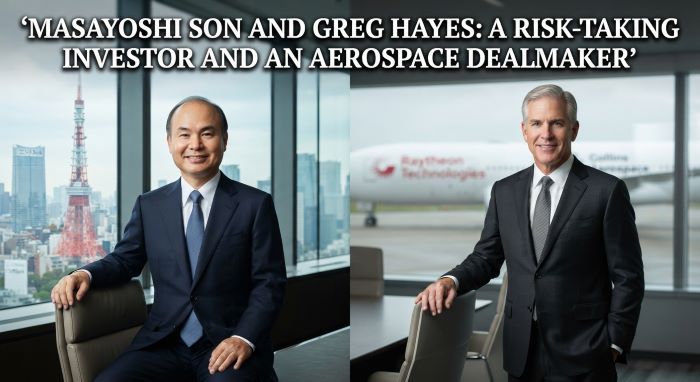
Masayoshi Son and Greg Hayes
Masayoshi Son likes to say he plans in 300-year terms. Greg Hayes spent his career counting costs, first as an accountant and then as the CEO who merged United Technologies with Raytheon. One is a founder who makes bold bets on the future. The other is a finance-minded operator who built one of the world’s largest aerospace and defense companies.
Masayoshi Son and Greg Hayes have no business link on record. Their names come up together because both led massive deals in tech and industry and both are known for speaking their minds. This article compares their lives, careers, leadership styles, and where each stands in 2026.
Quick Facts
| Detail | Masayoshi Son | Greg Hayes |
|---|---|---|
| Full name | Masayoshi Son | Gregory J. Hayes |
| Born | August 11, 1957, Tosu, Saga, Japan | Around 1960 or 1961, grew up in Williamsville, New York |
| Age in 2026 | 69 | About 65 |
| Education | BA in economics, UC Berkeley (1980) | BA in economics, Purdue University (1982); attended Cornell |
| Company | SoftBank Group (founded 1981) | United Technologies, then RTX |
| Top role | Founder, chairman, and CEO of SoftBank | CEO of UTC (2014 to 2020) and RTX (2020 to 2024) |
| Biggest deal | ARM purchase (2016) and OpenAI bets | UTC and Raytheon merger (2020) |
| 2026 update | Doubling down on OpenAI and AI infrastructure | Serves on corporate boards, including BD |
Masayoshi Son: The Founder Who Bets Big
Early Life and Education
Masayoshi Son was born in Tosu, on Japan’s southern island of Kyushu, to a family of Korean descent. His family was poor when he was young, and he faced discrimination as a child. His father later built a business in pachinko parlors and other ventures.
At 16, Son moved to California. He finished high school there and studied economics at the University of California, Berkeley. While in school, he built an electronic translator and sold the rights to Sharp for about $1 million. He graduated in 1980 and went home to Japan.
Career Timeline
- 1981: Founded SoftBank as a software distributor in Tokyo.
- 1990s: Bought stakes in Yahoo and the tech trade show Comdex.
- 2000: Invested about $20 million in Alibaba, a stake later worth tens of billions.
- 2006: Bought Vodafone Japan, moving into mobile phones.
- 2013: Bought a majority stake in Sprint.
- 2016: Bought British chip designer ARM for about $32 billion.
- 2017: Launched the $100 billion Vision Fund.
- 2019: Took heavy losses on WeWork.
- 2023: Took ARM public again on the Nasdaq.
- 2025: Helped launch the Stargate AI project with OpenAI and Oracle and pledged tens of billions to OpenAI.
- 2026: SoftBank posted strong gains tied to its OpenAI stake.
Son Today
In 2026, Son is still SoftBank’s chairman and CEO. He has said artificial superintelligence is coming within years and that SoftBank must lead in it. He has also said he dropped earlier plans to retire in his 60s. His heavy bets on OpenAI and AI data centers have drawn praise from some investors and worry from others.
Greg Hayes: The Accountant Who Built RTX
Early Life and Education
Gregory J. Hayes grew up in Williamsville, a suburb of Buffalo, New York. He graduated from Williamsville South High School in 1978. He went to Cornell University, where he played football and studied pre-law for a year.
He then moved to Purdue University’s Krannert School of Management and earned a bachelor’s degree in economics in 1982. He later became a certified public accountant, a skill set that shaped his whole career.
Career Timeline
- 1980s: Joined Sundstrand Corporation, an aerospace parts maker, in finance roles after college.
- 1999: Became part of United Technologies when UTC bought Sundstrand.
- 2008: Became UTC’s chief financial officer.
- November 2014: Became CEO of United Technologies.
- 2016: Became chairman of UTC.
- 2017: Joined, then resigned from, a White House manufacturing council.
- 2018: Closed UTC’s purchase of Rockwell Collins for about $30 billion.
- April 2020: Merged UTC with Raytheon, spun off Otis and Carrier, and became CEO of Raytheon Technologies.
- 2023: Saw the company renamed RTX.
- May 2024: Stepped down as CEO, with Chris Calio taking over.
- March 2025: Joined the board of medical technology company BD.
- April 2025: Left the RTX board as Calio became chairman.
Hayes Today
In 2026, Hayes no longer runs RTX. He serves on the boards of other large companies, including BD, and is known in business circles for his frank views on supply chains, defense spending, and China. In 2022, China placed sanctions on him over arms sales to Taiwan.
Two Kinds of Deal Makers
Masayoshi Son and Greg Hayes both made their names through huge deals, but their styles are very different.
| Style | Masayoshi Son | Greg Hayes |
|---|---|---|
| Background | Founder and entrepreneur | Accountant and finance chief |
| Approach | Bets on what the future may bring | Focuses on cash flow and costs |
| Big win | Alibaba investment | Building RTX into a defense giant |
| Big setback | WeWork and early Vision Fund losses | Pandemic hit to jet engine business |
| Known for | Bold visions and big speeches | Plain talk and blunt quotes |
Son buys stakes in young companies he thinks will change the world. Some pay off in a huge way. Others lose billions.
Hayes built through mergers that joined mature businesses. He bought Rockwell Collins, then joined UTC with Raytheon, and split off Otis and Carrier so the new company could focus on aerospace and defense.
Facing Hard Times
Both men led through rough years. The UTC and Raytheon merger closed in April 2020, just as COVID-19 grounded flights around the world. Demand for jet engines and plane parts fell fast. Hayes had to cut costs while bringing two huge companies together.
Son faced his own storm when WeWork’s value collapsed in 2019 and the Vision Fund posted record losses. He later admitted to investors that some of his choices were poor, but he kept investing.
Technology and Chips
Both leaders depend on advanced chips. ARM, which SoftBank controls, designs the processors in almost every smartphone. RTX relies on advanced electronics for radar, missiles, and avionics. For both Masayoshi Son and Greg Hayes, the race for better chips is central to their industries.
Why People Search for Them Together
Searches for Masayoshi Son and Greg Hayes often come from readers studying big business leaders and large deals. Others compare Masayoshi Son and Greg Hayes to understand the difference between a founder who takes big risks and an operator who builds through careful mergers.
Lessons From Their Paths
- Know your strengths. Son leads with vision, and Hayes with numbers.
- Think big. Both took on deals worth tens of billions.
- Expect shocks. WeWork and the pandemic tested both leaders.
- Speak plain. Both are known for saying what they think.
- Plan the handoff. Hayes passed RTX to Calio in a planned transition.
Views on China and Global Trade
Both men have dealt with China in very different ways. Son made one of his biggest fortunes from Alibaba, a Chinese company. Hayes, as head of a top defense contractor, warned about relying on Chinese supply chains and faced Chinese sanctions over arms sales to Taiwan. For Masayoshi Son and Greg Hayes, global politics has been part of doing business.
Legacy and Influence
Son’s legacy will depend on whether his AI bets pay off. If they do, SoftBank could become one of the most powerful tech investors in history. Hayes’s legacy is RTX itself, a company with jet engines, missiles, and avionics under one roof. The legacies of Masayoshi Son and Greg Hayes will be judged by how their giant bets play out over the next decade.
Speaking Style
Son is known for dramatic speeches, bold charts, and grand predictions at SoftBank events. Hayes was known on earnings calls for blunt answers and plain talk about costs, supply chains, and defense budgets. Both styles made headlines.
Final Thoughts
Masayoshi Son and Greg Hayes show two ways to reach the top of global business. Son built SoftBank from nothing and keeps betting on the next big wave, now artificial intelligence. Hayes rose from accountant to CEO and built RTX into one of the largest defense companies in the world.
In 2026, Son keeps pushing SoftBank deeper into AI, while Hayes advises other companies from the boardroom.
Key Takeaways
- Masayoshi Son was born August 11, 1957. Greg Hayes was born around 1960 or 1961.
- Masayoshi Son and Greg Hayes have no known business link but both led huge deals.
- Son studied economics at UC Berkeley and founded SoftBank in 1981.
- Hayes earned an economics degree from Purdue and became a CPA.
- Hayes led UTC from 2014 and RTX from 2020 until he stepped down as CEO in May 2024.
- In 2026, Son is betting big on OpenAI, and Hayes serves on boards such as BD.