Atardecer de Hoy
Type “atardecer de hoy” into a search bar and you ask one of the oldest questions people have: when does the sun go down today? The phrase is Spanish for “today’s sunset,” and millions of people search it each month to plan a walk, a photo, a prayer, a dinner on the terrace, or the drive home. The answer changes by a minute or two each day and by a lot from one city to the next.
This guide explains what the phrase means, the fastest ways to get the exact time for your location, what happens in the sky before and after, and how to use that window well.
What “Atardecer de Hoy” Means
The phrase breaks into three words:
- Atardecer: dusk, or the time when the afternoon turns to evening. As a noun it means sunset. As a verb it means “to get dark.”
- De: of.
- Hoy: today.
So atardecer de hoy translates to “today’s sunset.” You will also see two close terms in Spanish:
- Puesta de sol or puesta del sol: the moment the sun sets. This is the more exact term for the event itself.
- Ocaso: a formal word for sunset, common in weather reports and almanacs.
- Anochecer: nightfall, the point when it gets dark.
In daily speech, “atardecer” covers the whole stretch of warm light at the end of the day, not just the instant the sun vanishes. That wider meaning explains why people use it for photos and plans.
How to Find the Atardecer de Hoy Where You Are
You can get the time in seconds. Pick the method that fits what you have in hand.
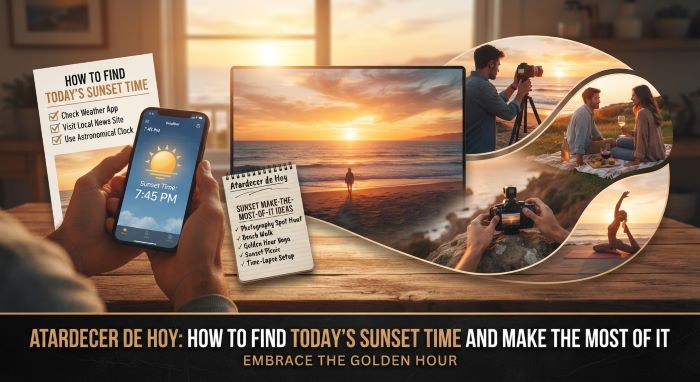
- Search engine. Type the phrase, or “sunset today,” with location turned on. Most search engines show a box with the local time of sunset at the top of the page.
- Phone weather app. The built-in weather apps on iPhone and Android list sunrise and sunset for each saved city. Scroll past the hourly forecast.
- Voice assistant. Ask your phone or smart speaker, “What time is sunset today?” It uses your current location.
- Smartwatch. Many watch faces have a sunrise and sunset widget. It updates as you travel.
- Astronomy websites. Sites such as timeanddate.com and the NOAA Solar Calculator give sunset, twilight times, day length, and the sun’s direction for any place and date.
- Photo planning apps. Apps built for photographers show where on the horizon the sun will set, laid over a map.
Two things affect accuracy:
- Location. Sunset can differ by several minutes between two ends of a large city, and by much more across a time zone.
- Your horizon. The listed time assumes a flat, clear horizon at sea level. Mountains to the west hide the sun sooner. A high viewpoint keeps it in sight a bit longer.
What Counts as Sunset
Sunset has a strict definition. It is the moment the top edge of the sun slips below the horizon.
There is a twist. The air bends light, so when you see the sun touch the horizon, it has in fact dropped below it. You are looking at an image lifted by the atmosphere. That bending adds a few minutes of daylight at each end of the day.
The Phases of Light Around Sunset
The best light does not last for one moment. It moves through stages, and each has its own look.
| Phase | When | What you see |
|---|---|---|
| Golden hour | About the last hour before sunset | Warm, soft, low light and long shadows |
| Sunset | Top of the sun meets the horizon | The sun vanishes, colors peak near the horizon |
| Civil twilight | Sun 0 to 6 degrees below the horizon | Bright sky, enough light to see without lamps |
| Blue hour | Within civil twilight, about 20 to 40 minutes | Deep blue sky, city lights come on |
| Nautical twilight | Sun 6 to 12 degrees below | The horizon fades, bright stars appear |
| Astronomical twilight | Sun 12 to 18 degrees below | Last trace of glow before full night |
How long each phase lasts depends on latitude and season. Near the equator the sun drops almost straight down, and twilight passes fast. Far from the equator it sinks at a shallow angle, and dusk can linger for an hour or more. In high summer at high latitudes, the sky may never get dark at all.
Why the Time Changes Each Day
Earth tilts on its axis by about 23.4 degrees. As the planet circles the sun, that tilt points your half of the world toward the sun for part of the year and away for the rest. The result is longer days in summer and shorter ones in winter.
A few patterns follow from that:
- The change is fastest near the equinoxes. In March and September, sunset can shift by two minutes or more per day at middle latitudes.
- The change slows near the solstices. In late June and late December, the time holds almost steady for a couple of weeks.
- The earliest sunset does not fall on the shortest day. In the Northern Hemisphere, the earliest sunsets come in early to mid December, before the winter solstice. Earth’s oval orbit and its tilt shift solar noon across the year, which causes the gap.
- Clock changes move it by an hour. Where daylight saving time applies, sunset jumps an hour later in spring and an hour earlier in autumn.
Latitude sets how wide the swing is. Cities near the equator see sunset within the same half hour all year. Cities far north or south see it move by many hours between June and December.
How to Tell if the Atardecer de Hoy Will Be Colorful
Knowing the time is half the plan. The other half is the sky.
Sunsets turn red and orange for a simple reason. Near the horizon, sunlight crosses far more air than at midday. Air molecules scatter blue light out of the beam, and the warm colors pass through.
Clouds decide whether that color fills the sky. Use this checklist an hour or two ahead:
- High, thin clouds are best. Cirrus and altocumulus catch the low light from below and glow pink and red.
- Thirty to seventy percent cloud cover works well. A blank sky gives a clean but plain sunset. Full overcast gives grey.
- A clear gap on the western horizon matters most. The sun needs an opening to light the clouds above you.
- Clean air helps. The hours after rain often bring strong color, since the air is clear and broken clouds remain.
- Low, thick cloud in the west blocks the show. If the western horizon looks like a wall, lower your hopes.
Stay ten to twenty minutes after the sun sets. The strongest reds often arrive after it has gone, when light from below the horizon hits the high clouds.
Tips for Photographing Today’s Sunset
You do not need a costly camera. A phone does the job with a little care.
- Arrive early. Get there 30 to 45 minutes ahead to find your spot and watch the light change.
- Clean the lens. A smudge turns the sun into a blur.
- Lower the exposure. Tap the bright part of the sky on your phone and drag the brightness down. This keeps the color rich.
- Add a foreground. A tree, a pier, a person, or a building in silhouette gives the scene depth.
- Keep the horizon level. Turn on the grid in your camera settings.
- Put the horizon off center. Give two thirds of the frame to the sky when the clouds are strong, or to the ground when the reflections are.
- Use HDR with care. It helps balance bright sky and dark ground, but strong settings look fake.
- Steady the camera in low light. Rest your phone on a wall or use a small tripod as the light fades.
- Turn around. The sky behind you often glows pink at the same time.
- Shoot through blue hour. City lights against a deep blue sky make some of the best frames of the evening.
One safety rule: never look at the sun through a camera’s optical viewfinder, a telescope, or binoculars. It can damage your eyes in an instant.
Ways People Use the Sunset Time
The search for atardecer de hoy is not just about photos. The time shapes plans of many kinds.
- Exercise: runners, cyclists, and hikers use it to finish before dark or to carry a light.
- Driving: the sun sits low and in your eyes for the half hour before it sets. Keep sunglasses in the car and clean the windshield.
- Religious practice: in Islam, the Maghrib prayer and the breaking of the fast in Ramadan follow sunset. In Judaism, Shabbat and holidays begin near sunset.
- Events: weddings, proposals, and outdoor dinners are often timed to golden hour.
- Fishing and wildlife watching: many animals become active at dusk.
- Gardening: evening is a good time to water, since less is lost to heat.
- Home routines: smart lights and blinds can follow the sunset time on their own.
Good Places to Watch
You can enjoy the atardecer de hoy from almost anywhere with a view to the west. Some spots work better than others:
- West-facing coasts and lakeshores, where the sun drops into water and the surface doubles the color.
- Hills and lookouts, which lift you above buildings and haze.
- Rooftops and upper floors in cities.
- Open fields and deserts, with wide, clean horizons.
- Bridges and waterfronts, for reflections and skyline shapes.
In the Southern Hemisphere and the Northern Hemisphere alike, the sun sets in the west. The exact point slides north of west in the northern summer and south of west in the northern winter, so a spot that lines up in June may not in December.
Common Questions
What does “atardecer de hoy” mean in English? Today’s sunset, or this evening’s dusk.
Is the time the same across a country? No. It depends on your longitude, latitude, and time zone.
How long does a sunset last? The sun’s disc takes about two to three minutes to cross the horizon at middle latitudes. The color can last 20 to 30 minutes more.
When does full darkness arrive? At the end of astronomical twilight, which can come an hour or more after sunset.
Does the sun set at the same time each day? No. It shifts by seconds to minutes each day through the year.
Key Takeaways
- Atardecer de hoy is Spanish for “today’s sunset.” “Atardecer” also covers the wider period of evening light, not just the instant the sun sets.
- Get the exact time from a search engine, a weather app, a voice assistant, a smartwatch, or an astronomy site. Turn on location for a result that fits where you stand.
- Sunset is the moment the top edge of the sun drops below the horizon. Hills, buildings, and your height can shift what you see by a few minutes.
- The light moves through golden hour, sunset, blue hour, and three stages of twilight. The best color often comes 10 to 20 minutes after the sun is gone.
- The time shifts each day due to Earth’s tilt and orbit. It changes fastest near the equinoxes and slowest near the solstices.
- High, thin clouds with a clear western horizon give the most colorful skies. Thick low cloud in the west blocks them.
- For photos, arrive early, lower the exposure, add a foreground, keep the horizon level, and keep shooting into blue hour.
- The sunset time also guides exercise, driving, prayer, events, and home routines, so it is worth a quick check each day.