

Frank Sinatra and Johnny Cash
Frank Sinatra sang “My Way” in a tuxedo, with a big band behind him and a glass in his hand. Johnny Cash sang “I Walk the Line” in black, with a guitar and a chugging rhythm. Their styles couldn’t be more different. But both became giants of American music, both fell from the top, and both came roaring back.
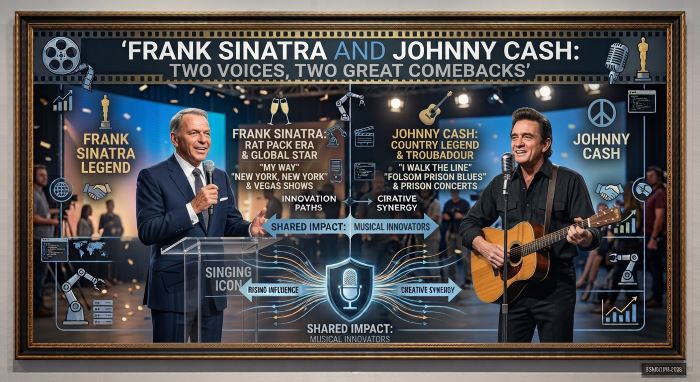
Frank Sinatra and Johnny Cash never made a record together, and there’s no well-known partnership between them. Still, fans love to compare them. They’re two of the most recognizable voices of the 20th century, and both pulled off career comebacks that are now legendary. This article looks at their lives, music, and legacies.
Quick Facts
| Detail | Frank Sinatra | Johnny Cash |
|---|---|---|
| Born | December 12, 1915, Hoboken, New Jersey | February 26, 1932, Kingsland, Arkansas |
| Died | May 14, 1998, age 82 | September 12, 2003, age 71 |
| Nickname | Ol’ Blue Eyes, The Chairman of the Board | The Man in Black |
| Education | Left A.J. Demarest High School without graduating | Dyess High School, Arkansas |
| Signature songs | “My Way,” “New York, New York,” “Fly Me to the Moon” | “I Walk the Line,” “Ring of Fire,” “Folsom Prison Blues” |
| Big comeback | From Here to Eternity (1953) | American Recordings (1994) |
Frank Sinatra: Ol’ Blue Eyes
Early Life and Education
Francis Albert Sinatra was born in Hoboken, New Jersey, the only child of Italian immigrants. His mother, Dolly, was a local political figure, and his father was a boxer and firefighter. Frank attended A.J. Demarest High School but left without graduating. He sang in local clubs and on the radio as a teenager, inspired by Bing Crosby.
Career Timeline
- 1935: Won a radio talent contest with the Hoboken Four.
- 1939: Joined Harry James’s big band.
- 1940: Joined Tommy Dorsey’s band and became a star.
- 1940s: Became the first teen idol, with “bobby-soxers” screaming at his shows.
- Late 1940s to early 1950s: His career collapsed. His voice suffered, his record label dropped him, and his films flopped.
- 1953: Won the Oscar for Best Supporting Actor for From Here to Eternity, kicking off a massive comeback.
- 1950s: Recorded classic albums for Capitol Records with arranger Nelson Riddle, including In the Wee Small Hours.
- 1960: Founded his own label, Reprise Records.
- 1960s: Led the Rat Pack in Las Vegas with Dean Martin and Sammy Davis Jr.
- 1969: Released “My Way.”
- 1980: Recorded “Theme from New York, New York.”
- 1985: Received the Presidential Medal of Freedom.
- 1998: Died in Los Angeles.
Johnny Cash: The Man in Black
Early Life and Education
J.R. Cash grew up in Dyess, Arkansas, in a family of cotton farmers. He worked in the fields as a child and lost his older brother Jack in a sawmill accident when he was 12. He graduated from Dyess High School in 1950 and joined the US Air Force, where he served as a radio operator in Germany.
Career Timeline
- 1955: Signed with Sun Records in Memphis.
- 1956: Released “I Walk the Line.”
- 1963: Released “Ring of Fire.”
- 1968: Recorded At Folsom Prison and married June Carter.
- 1969: Launched The Johnny Cash Show on ABC.
- 1970s to 1980s: Struggled with addiction and fading record sales. His label dropped him in the 1980s.
- 1992: Inducted into the Rock and Roll Hall of Fame.
- 1994: Began his American Recordings series with producer Rick Rubin, winning a Grammy.
- 1996: Received the Kennedy Center Honors.
- 2002: Recorded his cover of “Hurt.”
- 2003: Died in Nashville.
Two Great Comebacks
The strongest link between Frank Sinatra and Johnny Cash is their comebacks.
| Comeback Detail | Frank Sinatra | Johnny Cash |
|---|---|---|
| Low point | Early 1950s: no label, poor films, voice trouble | 1980s: dropped by Columbia, addiction struggles |
| Turning point | Fought for a dramatic role in From Here to Eternity | Teamed with Rick Rubin on stripped-down recordings |
| Result | Oscar win and a string of classic albums | New young fans and Grammy wins |
| Legacy | His greatest recordings came after the comeback | His late work is among his most respected |
Sinatra’s comeback began when he begged for the role of Private Maggio in From Here to Eternity, taking what was said to be a small fee. His performance won him an Oscar and revived his music career.
Cash’s comeback came when Rick Rubin, a producer known for hip-hop and rock, signed him. Their bare, intimate recordings of Cash singing alone with a guitar won over a new generation, including fans of grunge and alternative rock.
Two Kinds of Cool
Frank Sinatra and Johnny Cash both defined cool, but in different ways.
Sinatra was the sophisticated urban crooner, with sharp suits, fedoras, and Las Vegas glamour. His phrasing, the way he shaped each line, influenced generations of singers.
Cash was the rebel outsider, dressed in black, singing about prisoners and the poor. His deep voice and simple rhythm made him a hero to rock and punk musicians as well as country fans.
Musical Influence
Both men shaped music far beyond their genres.
Sinatra set the standard for interpreting songs. Singers from Tony Bennett to Michael Bublé have cited him as a model. His concept albums of the 1950s helped turn the album into an art form.
Cash connected country, rock, folk, and gospel. Bob Dylan, U2, and countless others have named him as an influence. He was one of the few artists inducted into both the Country Music Hall of Fame and the Rock and Roll Hall of Fame.
Why People Search for Them Together
Searches for Frank Sinatra and Johnny Cash often come from fans of classic American music. Both are among the best-selling artists of the 20th century, and both remain popular with listeners who weren’t born when they were at their peak.
Fans also compare their comeback stories. Frank Sinatra and Johnny Cash show that even legends can fall, and that talent and hard work can bring them back stronger than before.
Lessons From Their Comebacks
Frank Sinatra and Johnny Cash both teach a powerful lesson: a setback doesn’t have to be the end.
- Fight for the right opportunity. Sinatra pushed hard for a role many thought he couldn’t play.
- Strip it down. Cash’s comeback worked because Rubin removed the polish and let his voice carry the songs.
- Find new audiences. Both reached younger fans who’d never heard their earlier work.
- Stay true to yourself. Neither changed who they were to succeed. They found new ways to show it.
Fast Facts
- Sinatra recorded more than 1,000 songs over his career.
- Cash recorded with artists as different as Bob Dylan and U2.
- Sinatra’s “My Way” is one of the most-played songs at funerals in the UK.
- Cash’s last music video, “Hurt,” won a Grammy and is often called one of the greatest videos ever made.
These facts help explain why Frank Sinatra and Johnny Cash still feel modern decades later.
Influence on Today’s Artists
Modern singers still borrow from both. Crooners like Michael Bublé and Harry Connick Jr. follow Sinatra’s lead, while country and Americana artists like Chris Stapleton and Sturgill Simpson carry Cash’s spirit.
Final Thoughts
Frank Sinatra and Johnny Cash were two of the greatest voices in American history. Sinatra brought elegance and swing, singing standards that became timeless. Cash brought raw honesty, giving a voice to the struggling and forgotten. Both fell hard and climbed back to new heights.
Their music still fills playlists today, from “Fly Me to the Moon” to “Hurt,” proving that great songs and great voices never go out of style.
Key Takeaways
- Frank Sinatra was born December 12, 1915, in Hoboken and died May 14, 1998. Johnny Cash was born February 26, 1932, in Arkansas and died September 12, 2003.
- Frank Sinatra and Johnny Cash never recorded together, but both staged legendary career comebacks.
- Sinatra left high school, rose with Tommy Dorsey’s band, and won an Oscar for From Here to Eternity in 1953.
- Sinatra founded Reprise Records, led the Rat Pack, and recorded “My Way” and “New York, New York.”
- Cash served in the Air Force, signed with Sun Records in 1955, and recorded At Folsom Prison in 1968.
- Cash’s comeback came through Rick Rubin’s American Recordings series, starting in 1994.
- Both influenced generations of singers and remain among the best-selling artists of the 20th century.