
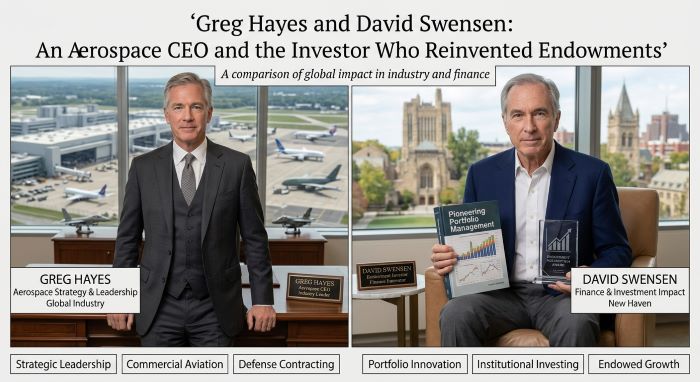
Greg Hayes and David Swensen
David Swensen took over Yale’s endowment in 1985 with about $1 billion to manage. By the time he died in 2021, it had grown past $31 billion, and his approach was being copied by universities around the world. Greg Hayes started as an accountant and rose to run United Technologies and then RTX, one of the largest aerospace and defense companies on earth.
Greg Hayes and David Swensen have no business link on record. One managed a company’s money and operations, the other managed a university’s investments. Both were numbers men who changed their fields. This article compares their lives, careers, and where their legacies stand in 2026.
Quick Facts
| Detail | Greg Hayes | David Swensen |
|---|---|---|
| Full name | Gregory J. Hayes | David Frederick Swensen |
| Born | Around 1960 or 1961, grew up in Williamsville, New York | January 26, 1954, River Falls, Wisconsin |
| Died | Living | May 5, 2021, New Haven, Connecticut |
| Age in 2026 | About 65 | Would have been 72 |
| Education | BA in economics, Purdue University (1982); attended Cornell | BA, University of Wisconsin (1975); PhD in economics, Yale (1980) |
| Best-known role | CEO of UTC (2014 to 2020) and RTX (2020 to 2024) | Chief investment officer of Yale (1985 to 2021) |
| Big idea | Mergers to build a defense and aerospace giant | The “Yale Model” of endowment investing |
| 2026 status | Serves on boards, including BD | His methods still guide endowments worldwide |
Greg Hayes: From CPA to CEO
Early Life and Education
Gregory J. Hayes grew up in Williamsville, a suburb of Buffalo, New York. He graduated from Williamsville South High School in 1978. He went to Cornell University, where he played football and studied pre-law for a year.
He then transferred to Purdue University’s Krannert School of Management and earned a bachelor’s degree in economics in 1982. He became a certified public accountant, a skill that shaped the way he ran companies for the rest of his career.
Career Timeline
- 1980s: Joined Sundstrand Corporation, an aerospace parts maker, in finance roles after college.
- 1999: Became part of United Technologies when UTC bought Sundstrand.
- 2008: Became UTC’s chief financial officer.
- November 2014: Became CEO of United Technologies.
- 2016: Became chairman of UTC.
- 2018: Closed the purchase of Rockwell Collins for about $30 billion, including debt.
- April 2020: Merged UTC with Raytheon and spun off Otis and Carrier.
- 2023: Saw the company renamed RTX.
- May 2024: Stepped down as CEO, with Chris Calio taking over.
- March 2025: Joined the board of medical technology company BD.
- April 2025: Left the RTX board as Calio became chairman.
Hayes Today
In 2026, Hayes serves on corporate boards, including BD. He is known in business circles for his blunt talk on supply chains, defense budgets, and China. In 2022, China placed sanctions on him over arms sales to Taiwan.
David Swensen: The Man Who Reinvented Endowments
Early Life and Education
David Swensen grew up in River Falls, Wisconsin. His father was a chemistry professor at the local state university, and his mother was a Lutheran minister. He was a strong student who loved math and economics.
He earned his bachelor’s degree from the University of Wisconsin in 1975. He then went to Yale for graduate school and studied under Nobel Prize winner James Tobin. He earned his PhD in economics in 1980.
Career Timeline
- 1980: Joined Salomon Brothers on Wall Street.
- 1981: Helped design one of the first currency swaps, between IBM and the World Bank.
- 1982 to 1985: Worked at Lehman Brothers.
- 1985: Returned to Yale at 31 as chief investment officer, taking a big pay cut.
- Late 1980s: Moved Yale’s money away from U.S. stocks and bonds into private equity, real estate, and hedge funds.
- 2000: Published Pioneering Portfolio Management, a guide for institutional investors.
- 2005: Published Unconventional Success, a guide for everyday investors that urged low-cost index funds.
- 2020: Saw the endowment pass $31 billion.
- May 5, 2021: Died of cancer at 67, still working at Yale.
Swensen’s Legacy
Under Swensen, Yale earned returns of about 13 percent a year over more than three decades, beating most peers. His “Yale Model” spread to colleges, foundations, and pension funds around the globe. Many of his former staff went on to run other endowments, a group often called the “Swensen tree.” In 2026, Yale’s endowment is worth well over $40 billion, and his books are still standard reading for investors.
Two Ways of Managing Money
Greg Hayes and David Swensen both spent their careers making money work harder, but in very different settings.
| Approach | Greg Hayes | David Swensen |
|---|---|---|
| Setting | Public company with shareholders | University endowment |
| Main goal | Grow profits and cash flow | Fund the university forever |
| Time frame | Results every quarter and multiyear plans | Decades and generations |
| Big tools | Mergers, spin-offs, cost control | Diversification and alternative assets |
| Style | Blunt and practical | Patient and disciplined |
Hayes had to answer to Wall Street every three months. Swensen managed money meant to last forever, so he could think in decades. Both, though, believed in discipline and careful analysis.
Big Bets That Paid Off
Hayes’s biggest bet was the 2020 merger of UTC and Raytheon. He split off Otis elevators and Carrier air conditioners so the new company could focus on jet engines, missiles, and defense systems. The deal closed just as the pandemic hit, which hurt the airline business, but RTX later grew on strong defense demand.
Swensen’s biggest bet was moving away from the stock and bond mix most schools used. He put Yale’s money into private equity, venture capital, real estate, and other assets that were less common at the time. Critics called it risky. Results proved him right for decades.
Values Beyond Money
Swensen was known for turning down huge Wall Street salaries to work for Yale. He spoke out against high fees in the investment world and urged regular people to use cheap index funds rather than paying expensive managers.
Hayes was known for speaking plain truths to investors and politicians. He warned about weak supply chains and said the defense industry needed steady funding to keep the country safe. In 2017, he left a White House manufacturing council.
Why People Search for Them Together
Searches for Greg Hayes and David Swensen often come from finance students and investors who study great money managers and corporate leaders. Comparing Greg Hayes and David Swensen shows how running a company and running an endowment call for different skills but the same discipline.
Lessons From Their Paths
- Master the numbers. Hayes was a CPA, and Swensen held a PhD in economics.
- Think long term. Swensen planned for generations, and Hayes for the future of defense.
- Be willing to break from the crowd. Swensen’s model and Hayes’s merger both drew doubters.
- Keep costs low. Both cared about fees and spending.
- Train the next generation. Swensen mentored many investment chiefs, and Hayes planned his handoff.
Influence on Their Industries
Greg Hayes and David Swensen both left marks that outlast their time in charge. Hayes’s RTX remains a top supplier of engines, missiles, and avionics to the U.S. and its allies. Swensen’s model changed how billions of dollars in endowments are invested. For anyone studying Greg Hayes and David Swensen, the key lesson is that clear ideas, carried out with discipline, can reshape an entire field.
Final Thoughts
Greg Hayes and David Swensen came from Midwest and upstate New York roots and rose to the top of finance in different ways. Hayes turned accounting skills into the leadership of a defense giant. Swensen turned an economics PhD into the most famous endowment strategy in the world.
In 2026, Hayes serves on boards and shares his views on industry, while Swensen’s ideas still guide endowments five years after his death.
Key Takeaways
- Greg Hayes was born around 1960 or 1961. David Swensen was born January 26, 1954, and died May 5, 2021.
- Greg Hayes and David Swensen have no known business link but were both finance-minded leaders.
- Hayes earned an economics degree from Purdue and became a CPA.
- Swensen earned a PhD in economics from Yale and ran its endowment from 1985 to 2021.
- Hayes led UTC and RTX and merged UTC with Raytheon in 2020.
- Swensen’s “Yale Model” grew the endowment from about $1 billion to more than $31 billion.